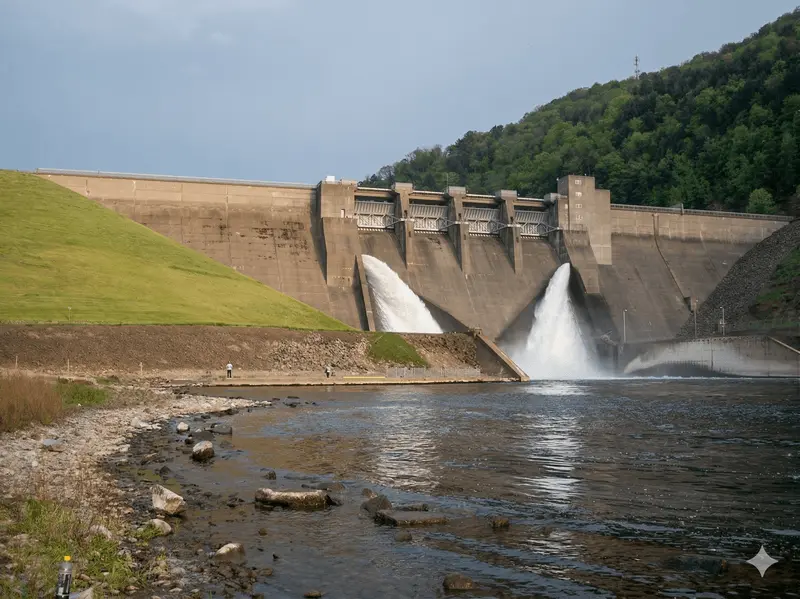
To the casual observer standing at the Big Bend overlook, the Kinzua Dam is a silent concrete monolith. But beneath that 189-foot-tall facade lies one of the most complex engineering feats in the eastern United States. As we move into the high-water season of April 2026, understanding the "gears" of this giant is essential for every resident from Warren to Pittsburgh.
1. The Art of the "Flood Plug"
At its core, the dam is a massive valve. The U.S. Army Corps of Engineers manages a drainage area of 2,180 square miles. When heavy spring rains hit, the dam doesn't just "stop" the water; it buffers it.
The dam utilizes six lower-level sluice gates and two concrete spillways. During a storm, the Corps closes these gates to "choke" the flow, allowing the reservoir level to rise safely. This creates a "storage cushion." Once the downstream river levels in places like Kittanning and Pittsburgh subside, the Corps slowly "bleeds" that stored water back into the river. Without this manual intervention, the Allegheny would be a wild, unpredictable threat to every home on its banks.
2. The Mountain-Top "Battery"
Perhaps the most misunderstood part of the Kinzua operation is the Seneca Pumped Storage Plant. If you look at the mountain directly above the dam, you’ll see a massive 2-billion-gallon "bathtub" carved into the ridge.
This is a hydroelectric storage system, functioning like a giant battery for the regional power grid:
The Night Shift: When electricity demand is low, the plant uses power from the grid to pump water from the Allegheny Reservoir uphill to the upper reservoir.
The Day Shift: When the sun comes up and the grid hits peak demand, the gates are opened. The water falls back down the mountain through massive "penstock" pipes, spinning turbines that generate up to 451 Megawatts of clean energy.
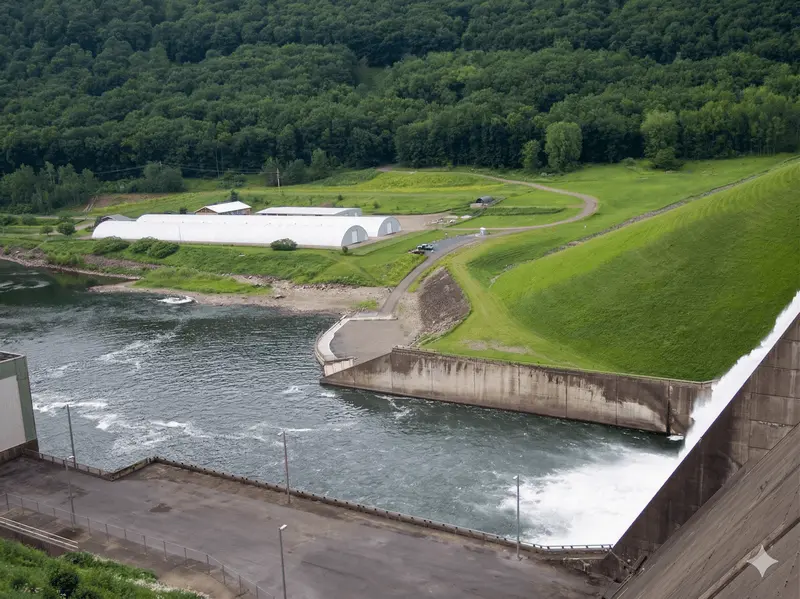
It is a cycle of "buying low and selling high" that keeps the lights on across Northwestern Pennsylvania during heatwaves and freezes.
3. The "Spring Pulse": Mimicking Mother Nature
Engineering isn't just about concrete and electricity; it's about biology. Because the dam blocks the natural flow of the river, it can inadvertently "starve" the ecosystem of the cycles it needs to survive.
To fix this, the Corps performs what is known as a Spring Pulse. By opening the gates wide for a short window (often moving upwards of 15,000 cubic feet per second), they create a "controlled flood." This high-velocity water scours the riverbed, cleaning the gravel where trout and walleye spawn and pushing vital nutrients downstream. For the fish, it’s a signal that spring has arrived; for the dam, it’s a way to act like a river again.
4. The Ghost in the Machine
We cannot discuss the workings of the dam without acknowledging what it sits upon. Below the current water line—roughly 120 feet down—lie the remains of the town of Kinzua and the Cornplanter Tract.
While the dam operates on physics and mathematics, its "social gears" are still turning. The 2026 Memorandum of Understanding with the Seneca Nation ensures that the mechanical future of the dam—including the upcoming safety modification studies—is no longer decided solely by engineers in Pittsburgh, but also by the people whose ancestral lands power the "battery" on the hill.
Local Impact Note: Residents are reminded that during high-outflow periods this month, water speeds in the "Tailwaters" can be deceptively fast. Always check the USACE outflow gauges before launching any watercraft below the dam.