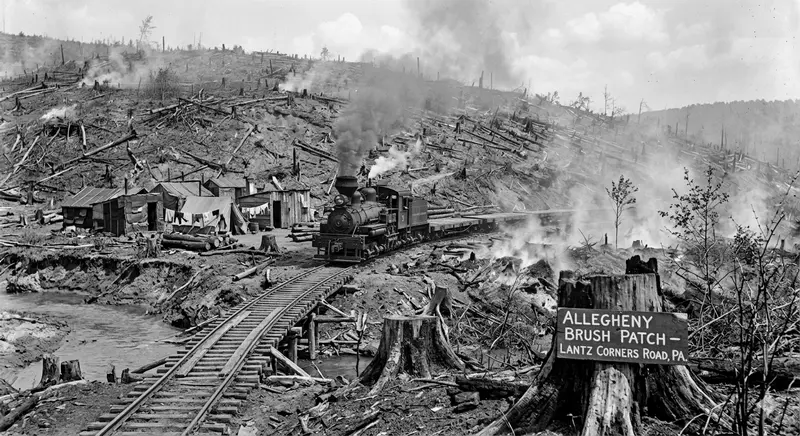
In the early 1900s, if you stood on a ridge overlooking the Allegheny Plateau, you wouldn't have seen the endless canopy of green that defines the region today. Instead, you would have looked out over a smoking, charred wasteland of stumps and mud.
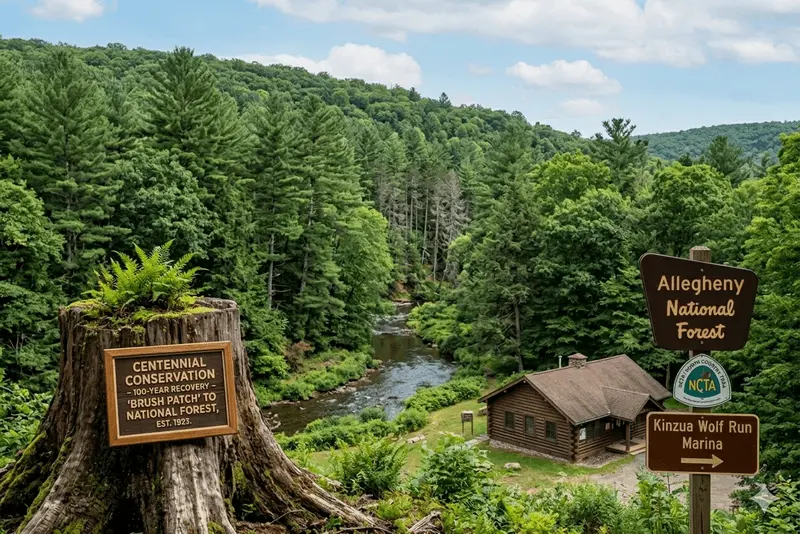
By 1920, the area was mockingly referred to as the "Allegheny Brush Patch." Yet, just a century later, it is the Allegheny National Forest (ANF)—a premier example of ecological resilience and one of the most successful reforestation projects in American history.
The Era of Extraction (1880–1920)
The devastation of the Allegheny Wilds was not an accident; it was the result of an industrial frenzy. At the turn of the 20th century, Pennsylvania led the nation in lumber production.
-
The "Wood Chemical" Boom: Unlike earlier selective logging, the wood chemical industry practiced "clear-cutting to the dirt." Every tree, regardless of size or species, was harvested to produce wood alcohol, acetate of lime, and charcoal.
-
Tannery Row: The massive Eastern Hemlocks were stripped of their bark to provide tannin for the region’s leather tanneries, often leaving the giant logs to rot on the forest floor.
-
The Fire Storms: With the shade gone, the sun parched the debris left behind. Sparks from logging locomotives frequently ignited massive wildfires that burned so hot they consumed the very organic matter in the soil.
-
Replanting the Plateau: The CCC planted millions of trees, primarily white pine and spruce, to stabilize the soil.
-
Building Infrastructure: They constructed the roads, fire towers, and pavilions (many still standing at sites like Loleta and Twin Lakes) that allowed the public to return to the woods.
-
Fighting the Fires: By creating fire breaks and responding to blazes, they allowed the natural "second-growth" forest—the cherry, maple, and oak—to finally take hold without being burned back.
The Turning Point: 1923
The recovery began with a radical idea: the federal government should buy up "the lands nobody wanted" to protect navigable rivers and restore the nation's timber supply.
Under the Weeks Act of 1911, President Calvin Coolidge officially established the Allegheny National Forest on September 24, 1923. At its birth, the ANF was a patchwork of exhausted farmland and blackened hillsides. The mission was clear but daunting: rebuild a forest from scratch.
The Architects of Recovery: The CCC
The Great Depression brought an unexpected workforce to the Allegheny: the Civilian Conservation Corps (CCC). Between 1933 and 1942, thousands of young men in "Roosevelt’s Tree Army" lived in camps across the plateau.
The Modern Forest: A Carbon and Timber Powerhouse
Today, the ANF is a "working forest" that serves as a global model for sustainable management.
| Then (1920s) | Now (2020s) |
| "The Brush Patch" | Over 513,000 acres of contiguous forest. |
| Eroding Soil | Deep, stable loam supporting world-class timber. |
| Minimal Wildlife | Thriving populations of bear, eagle, and elk. |
| Industrial Scars | A premier recreation destination for the NCT. |
The "Black Gold" of the Allegheny
One of the most remarkable ecological twists of the 100-year recovery is the rise of the Black Cherry (Prunus serotina). The specific soil and climate conditions of the plateau, combined with the way the forest grew back after the clear-cuts, produced the finest cherry timber in the world. Often called "Black Gold," this sustainable harvest now funds local schools and roads while providing habitat for countless species.
A Living Monument
The 100-year journey from "Brush Patch" to National Forest is a testament to the fact that nature, when given a chance and a helping hand, can heal. When you walk the North Country Trail today beneath 100-foot-tall black cherries, you aren't just walking through the woods—you are walking through a century-old miracle of conservation.