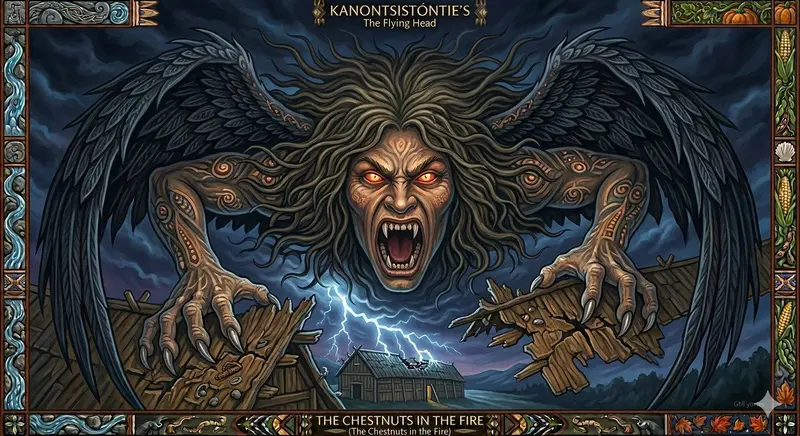
In the rich and complex tapestry of Haudenosaunee (Iroquois) oral tradition, the physical world is defined by a delicate tension between forces of creation and forces of obstruction. This duality is foundational, as seen in the creation myth of the Twin Sons and the enduring struggle with the Naked Bear (Gahwendo-wane).
While the Naked Bear represents nature’s ultimate excess and primal ferocity, another being challenges the survival of the First People: Kanontsistóntie’s, the Flying Head.
Unlike the Naked Bear, which Flint specifically engineered to complicate the forest floor, the Flying Head is an accidental monster—the "Ultimate Intruder." It is not an intended obstacle, but a cosmic glitch from the void, making it one of the most unpredictable and terrifying forces in the mythological landscape.
1. The Intruder from the Void: A Cosmic Accidental Glitch
To understand the Flying Head, one must recognize how it differs from other Haudenosaunee antagonists. Both Flint and Sky-Holder operate within the arena of creation (Image 0). The Naked Bear is a logical extension of Flint’s jagged, difficult domain (Images 8, 12).
Kanontsistóntie’s has no such creator. Legends suggest it is the residual echo of a powerful, ancient spirit who refused to move into the afterlife or, worse, a chaotic being from the deep void beyond the sky. This accidental nature makes it a unique threat: total unpredictability.
The original visual blueprint (Image 0) centers on a dynamic balance, symbolized by the "Shared Valley." The Flying Head is a force of pure unbalance. It is not interested in obstruction (like Flint) or dominance (like the Naked Bear); it is interested only in absolute, insatiable hunger. It possesses no body, yet it has an intense, magical focus on consuming humanity.
2. Physicality and Behavior: The Invisible Attacker
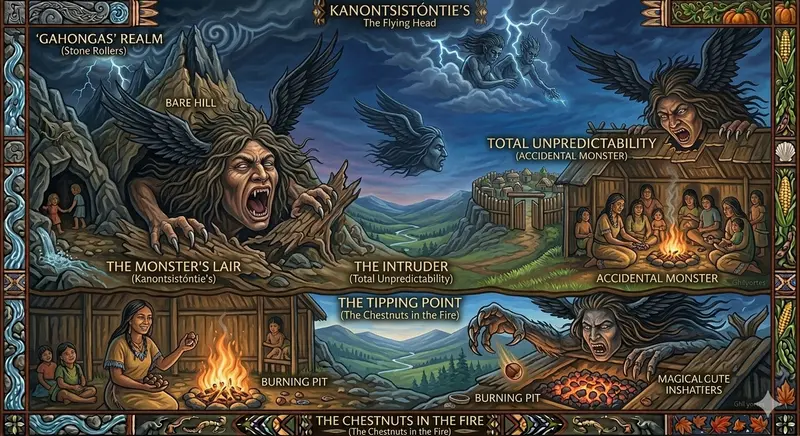
Visual descriptions of the Flying Head define a creature of nightmares, perfectly visualized as an agent of chaotic intrusion (Image 16).
-
Size and Structure: It is visualized as a colossal human head, easily larger than any human longhouse.
-
Insatiable Hunger: Its defining feature is a ravenous mouth. Some legends say it can unhinge its massive jaws like a snake, or that its entire internal structure is a powerful, supernatural "maw" that can process an entire deer—or small child—without needing a stomach.
-
The Mute Attacker: While common bears growl and the Thunder Beings issue thunderous roars, the Flying Head is horrifyingly silent. It has no voice. Its attack is often preceded only by a shift in the air pressure or a sudden, deep cold, leading many unsuspecting villagers (and the original visual description's "trapped" communities) into thinking a standard storm is approaching (Image 16, upper-left).
-
Claws and Mane: It possesses black, leathery, bat-like wings that sprout from its temples, allowing it to navigate above the canopy and attack from the sky. In later visual interpretations (represented in image 16), it is shown with powerful clawed arms specifically engineered to tear through the bark roofs of longhouses.
-
Metaphor for Intrusion: Historically, Kanontsistóntie’s represents external, unforeseen dangers that bypass conventional borders. Just as the creature bypassed the fortified "wooden gate" (Image 16, middle), the Haudenosaunee see this as a warning against being "trapped" by external systems and forces.
-
A Blueprint for Strategy: The story is told to illustrate that sometimes, the most insurmountable threats have a single, non-obvious point of vulnerability. It cannot be out-fought; it must be out-thought. The solution often involves localized, minimal-force actions that leverage the intruder's own excessive greed or miscalculations (in this case, total ignorance of hot chestnuts versus coals).
-
The Persistence of Identity: Despite total destruction (as depicted on the "Legacy of Resilience" register in Image 16), the siblings (representing the core community) survived by using the smallest elements of their traditional life (a longhouse fire, chestnuts, and cleverness).
3. The Tipping Point: The Chestnuts in the Fire
The most defining myth regarding the Flying Head illustrates that total brute strength and standardized defenses are useless against an entity from the void. The solution must be clever, localized, and psychological.
In this legend, the "Shared Valley" where the opposing worlds meet (Image 0) is reduced to a single human longhouse fire.
A group of women and children was sitting by their fire late one night (some versions say an orphan woman alone). They heard the monster approach but had no place to hide. Following a recurring visual pattern, they prepared a "burning pit" (Image 16, middle-left)—not to trap the beast, but as an ambush.
Visual Insight: The creature from the void attacks when humanity is already at its most isolated point of tension (the original visual's "great steeps" or "trapped" communities).
The woman, sensing the silence of the Flying Head above her roof, continued to roast chestnuts by her small fire. She began to eat them with apparent enjoyment.
The Flying Head, peering through the longhouse roof with its intense hunger (Image 16, middle-right), was fascinated. When it decided to strike, it believed the small chestnuts she was eating were actually glowing embers or hot coals. Mistaking the fire for food, the Flying Head crashed through the roof and snatched a handful of scorching coals from the burning pit, swallowing them in a single, silent gulp.
4. Legacy and Cultural Symbolism
The scorching pain of the burning coals shattered the Flying Head’s magical, mute invincibility. It was the first time it had experienced actual feedback from its environment. Incapacitated, it fled, shrieking—some say its vocal cords were formed in that final moment of agony—into the night, never to return.
In Seneca (Onöndowa’ga:) tradition, the Flying Head is more than just a ghost story; it is a foundational political and philosophical metaphor.
Like the legend of the Naked Bear and the eternal chase of the stars, the memory of the Flying Head ensures that the Haudenosaunee continue to look for clever, localized solutions to maintain the balance of existence—proving that even a monster from the void can be defeated by a well-timed roasted chestnut and a resilient human spirit.