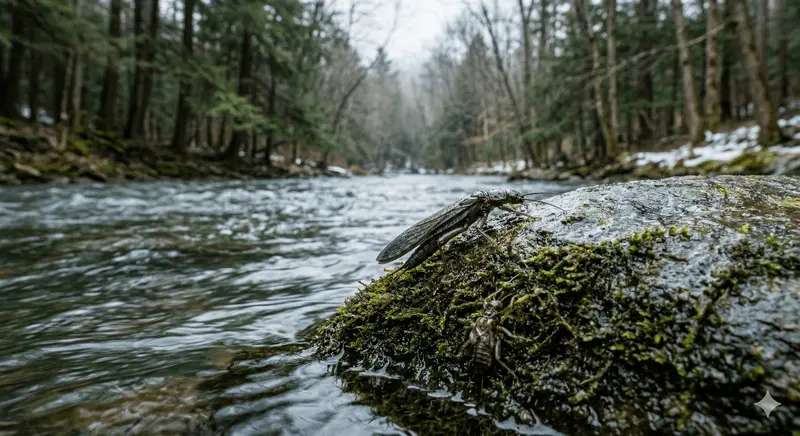
The spectacle of Opening Day, with its shoulder-to-shoulder crowds and bright fluorescent baits, will dominate the headlines this weekend. But for the serious angler—the one seeking the wild brook trout or the stream-bred browns of the Allegheny National Forest (ANF)—the true starting bell of the 2026 season rings in the quiet, overcast afternoons that follow. It is the arrival of the Early Brown Stonefly (Taeniopterygidae), the first reliable and arguably most overlooked hatch on the Plateau.
While the stocked trout are focused on high-calorie offerings, the wild populations are looking up. Decoding this brief, crucial event is the difference between a frustrating spring afternoon and a perfect day of dry fly fishing on the Plateau.
The Cold Water Nymph
To understand the Stonefly hatch, you must first understand the ANF’s river ecology in early April. The current water temperature (as noted in our "Cold Rush" dispatch) is hovering around 44°F. At this temperature, the Stonefly, which spent its winter as a nymph hiding under the substrate of the Kinzua and its tributaries, begins to move.
These nymphs, which are robust and dark brown/black, are active. The wild trout know this and have been feeding on them heavily. When air temperatures approach 50°F during the warmest part of the day (roughly 1:00 PM to 3:00 PM), the nymphs crawl out of the river onto bank-side rocks and trees, where the adults emerge.
Field Note: The presence of the Stonefly nymph is a primary indicator of high water quality. These insects cannot tolerate significant siltation or low oxygen levels. If you see their husks on the riverside rocks, you are standing next to a healthy, pristine waterway.
Recognizing the Hatch
The Early Brown Stonefly is not a dramatic, swarming event like the summer’s Green Drake hatch. It is a subtle affair. You must look closely for hints of activity.
-
The Adults: Look for small, dark insects with an elongated silhouette flying just above the water surface. Their wings are often darker than their body, appearing almost smokey-grey.
-
The Rise: Unlike the violent, explosive rises of later spring, a trout taking a Stonefly produces a gentle, sipping ring. The fish are often holding directly in the surface film, waiting for the clumsy adults to land.
-
Pattern Recommendation: A #12 - #16 Bead-head Black Stonefly Nymph or a Girdle Bug (a black nymph with rubber legs for action). The rubber legs are essential for triggering a wild trout in 44°F water.
-
Pattern Recommendation: A #14 - #16 Early Brown Stonefly Dry. We highly recommend a CDC Cawker Caddis pattern in dark brown or even an Elkhart Hair Caddis, which offers great flotation and visibility in the choppy, high water of April.
-
Technique: The "Leisenring Lift" is deadly here. Allow your dry fly to drift naturally over a feeding lie. As it passes, apply subtle tension to the line, causing the fly to rise slightly off the water. This movement mimics a stonefly attempting its first clumsy flight, and it will often provoke a strike.
Matching the PLATEAU (Entomology for the ANF)
The Kinzua Gazette recommends a precise strategy for this specific spring event.
1. The Nymph (The Reliable Strategy)
If the hatch hasn't yet started or if the trout aren't rising, go deep. The trout are still focused on the nymphs moving along the bottom.
2. The Dry (The Advanced Challenge)
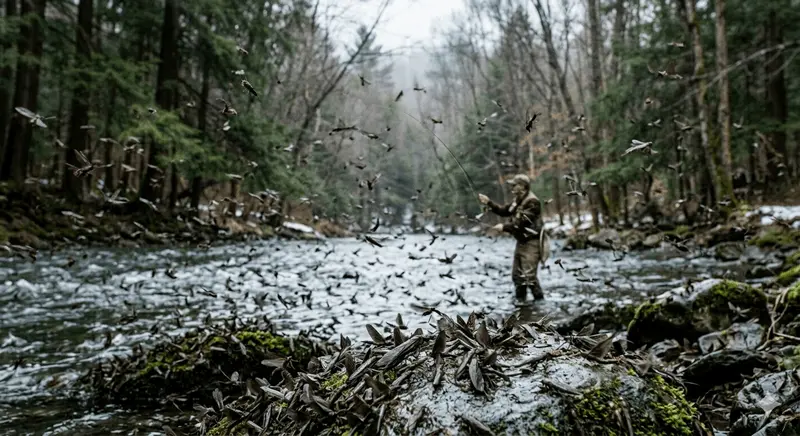
When the afternoon sun hits the water and you see those sipping rises, switch to a dry fly.
The Plateau Forecast
We predict the peak of the Early Brown Stonefly hatch will occur between April 6th and April 18th, assuming the daytime air temperatures hold near 50°F. If we experience another deep freeze, the hatch will stall.
While the opening weekend is for the masses, the stonefly belongs to the observer. Slow your retrieve, study the surface, and listen for the whispers. The Plateau is ready.
Sidebar: Stream Stewardship in April
As noted in our recent Mud Season advisory, the banks of the ANF are extremely fragile in April. When seeking the Stonefly hatch, prioritize entry points that are rocky or well-established, avoiding soft, grassy banks where access can accelerate erosion.