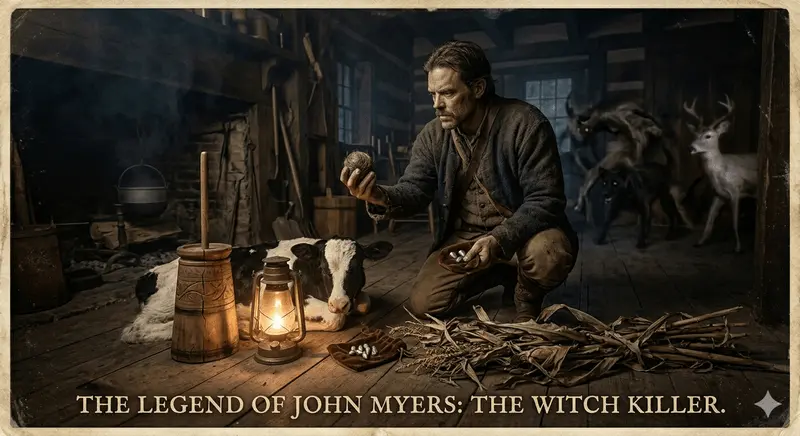
In the early 19th century, the wilderness of Warren and McKean counties was a place of claustrophobic density. To the European settlers carving out homesteads in the "Pennsylvania Wilds," the forest was not just a source of timber—it was a realm of shadows where the line between natural hardship and supernatural malice was razor-thin. When a cow stopped giving milk, a crop withered overnight, or a healthy child fell into a sudden wasting fever, the pioneers didn't look to science. They looked for a "hex."
And when they found one, they called for John Myers, the region's most legendary "Witch Killer."
The Nature of the "Killer"
Despite his grim title, John Myers was not an executioner of people. In the localized folklore of the Allegheny region, a "Witch Killer" was a specialized type of folk-healer or exorcist. His job was to "kill" the spell, not the caster.
Myers was a figure of immense local authority, navigating a world where "pow-wowing" (traditional German-Pennsylvanian folk magic) and frontier superstition blended into a literal defense against the dark arts. To the struggling farmers of the 1800s, Myers was a high-stakes troubleshooter—the only man who could confront the unseen forces curdling their butter and blighting their corn.
Tools of the Trade: Witch Balls and Silver
The lore surrounding Myers’ methods is a fascinating look at the "magical technology" of the era. He didn't rely on prayer alone; he used physical anchors to draw out and destroy curses:
-
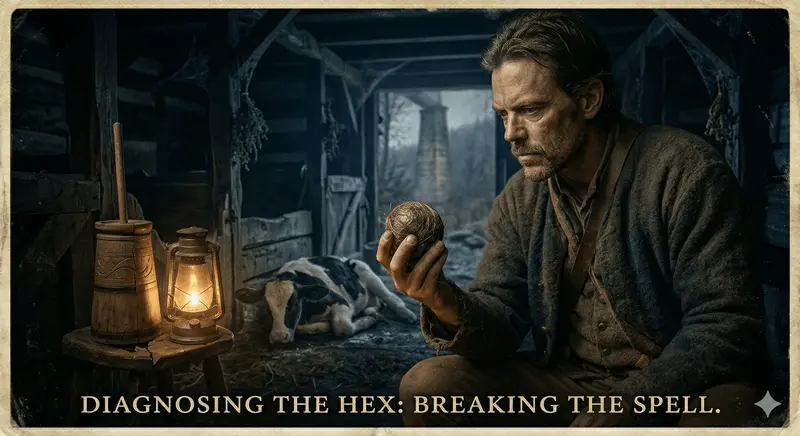
The Witch Ball: One of Myers’ primary tools was the "witch ball"—a strange, tactile object made of tightly wound hair, beeswax, and occasionally glass or iron filings. These spheres were believed to act like spiritual magnets, "catching" a curse before it could settle on a family or their livestock.
-
The Silver Bullet: In the most dire cases—where a "witch" was said to be physically harassing a farm in the form of a black dog or a strange white deer—Myers supposedly employed the silver bullet. Folklore states that a curse cast by a living person could only be broken by "shooting the image." Myers would draw a likeness of the suspected witch on a tree and fire a silver-cast ball into the heart of the drawing, theoretically breaking the spell (and, according to the legend, causing the real-life witch to fall ill).
A Daily Threat: Why the Lore Persists
Why did a figure like John Myers become so prominent in the Kinzua and Warren regions? The answer lies in the isolation.
In the 1820s, a homestead in the Allegheny foothills was miles from the nearest neighbor and days from a doctor. In that level of solitude, the mind turned the creaks of the forest into whispers and a string of bad luck into a targeted attack. Myers provided a sense of agency to people who felt powerless against the elements.
The Legacy of the Hex
Today, the stories of John Myers serve as a window into the "Highlands" culture of the early Allegheny frontier—a place where the woods were so vast they felt sentient. While we no longer hunt for witch balls in the foundations of old barns, the name of John Myers remains etched in the historical anecdotes of Warren County as a man who walked the line between the physical and the spectral, keeping the darkness of the "Big Woods" at bay.