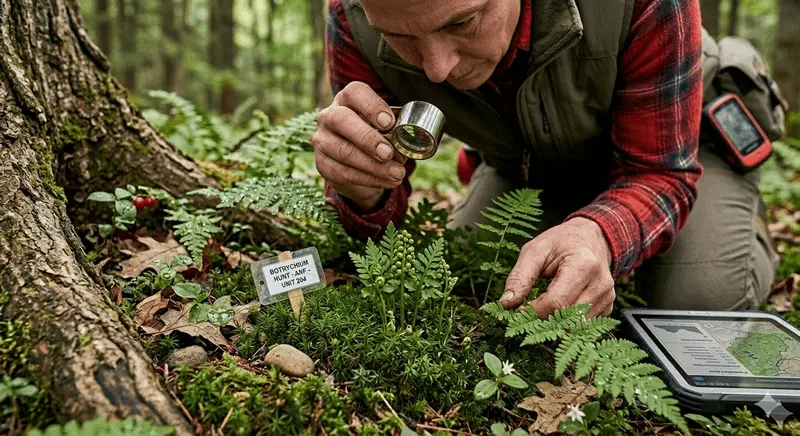
While the Allegheny National Forest (ANF) is famous for its towering multi-use canopy—producing the world’s finest veneer black cherry and hosting the highest density of black bears in the state—there is an entirely different mystery hidden just millimeters above the soil. This is the realm of the Moonwort (Botrychium), some of the strangest and most elusive plants on Earth.
For most visitors, the ANF floor is a beautiful chaos of ferns and leaf litter. But for specialized botanists, this ground-level undergrowth is a high-stakes map of indicators. Hunting the Moonwort is an act of extreme patience, requiring years of experience, precise GPS coordination, and a willing to crawl.
1. The Geometry of the Enigma
The Moonwort is not a flowering plant; it is a primal fern, a primitive 'fern-ally' whose ancestors pre-date the dinosaurs. Its appearance is geometric and precise.
A typical Moonwort, such as B. dissectum, looks almost mathematical. It generates a single, fleshy stem that splits. One part (the trophophore) looks like a tiny, precisely segmented green leaf. The second part (the sporophore) is a bizarre stalk that terminates in a cluster of pale, geometric spheres—the 'moon-like' sporangia that release billions of microscopic spores.
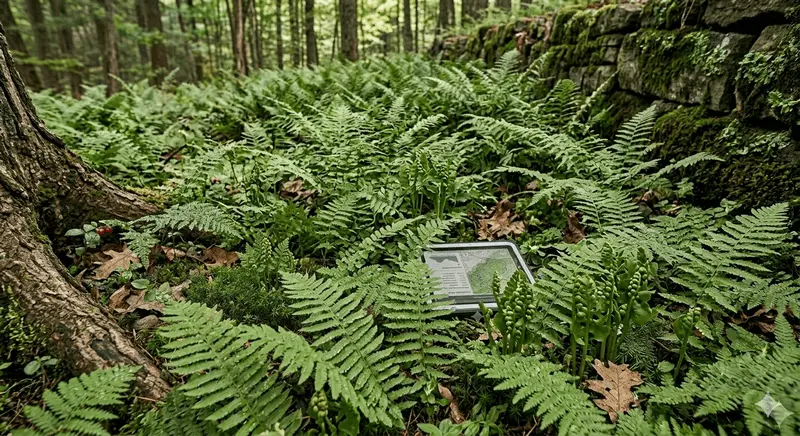
Finding them is a classic "needle in a haystack" problem. A full-grown Moonwort might only stand three inches tall, perfectly camouflaged against the textured forest floor seen in image_22.png. They don't appear every year; they can remain dormant underground, sustained by a complex symbiotic relationship with fungi, for a decade before conditions are right to emerge.
2. Hunting the Indicators: Following the Shadows
You cannot find a Moonwort by simply walking. You must look for its community. Botanists in the ANF use "Indicator Species" to narrow the search.
-
The Fern Companion: They thrive in the shadow of larger, more common ferns (like the Interrupted Fern and Sensitive Fern also visible in image_32.png).
-
The Old-Growth Hint: While they love disturbance (they often appear where a CCC trail from image_30.png was built 90 years ago), they require stable, fungal-rich soils found in the shadows of the oldest Hemlock groves.
-
GPS Coordination: Known populations are carefully mapped (using the exact GIS tablets from image_28.png) to monitor long-term trends and protect them during timber sales (the 'Green Gold' extraction described earlier).
-
The Hand Lens: When a suspected Moonwort is found, the final tool is a 10x or 20x jeweler's loupe. The botanist must examine the microscopic structure of the trophophore segments to differentiate between endangered species and common ones. This level of technical scrutiny mirrors the expert analysis applied to Black Cherry veneer logs in image_24.png.
3. The Modern Hunt: GPS and the Loupe
This is an example of modern high-tech stewardship in a low-tech environment. Today's "Moonwort Hunter"—often a botanist from the PGC (Pennsylvania Game Commission) wearing the technical expert attire seen in image_24.png and image_28.png—relies on precise data.
4. Stewardship in the Miniature
Why does a massive National Forest care about a tiny, three-inch fern? Because the presence of diverse Moonwort populations is the ultimate certificate of forest health. They signal a complex, stable fungal web beneath the surface. Protecting them is an act of Stewardship in the Miniature, ensuring that the entire forest ecosystem—from the high black cherry canopy down to the geometric wonders in the soil—remains vibrant and intact.