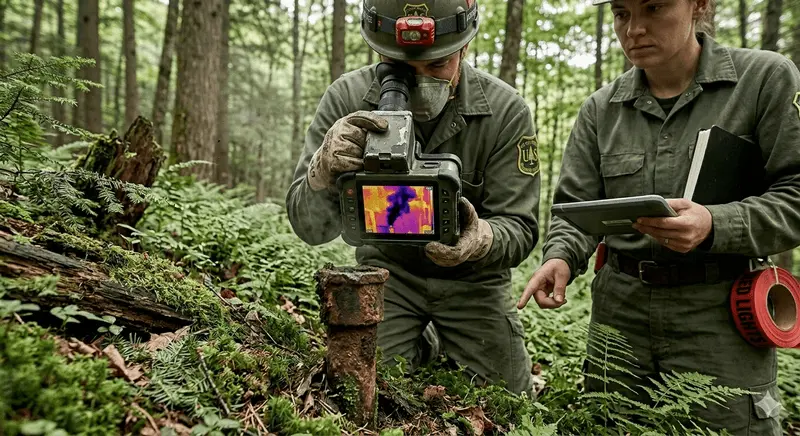
The Allegheny National Forest sits atop the birthplace of the American oil industry. While the "Green Gold" black cherry grows above, the "Black Gold" of the 19th century remains a lingering shadow below. Scattered across the High Plateau are thousands of "Ghost Wells"—iron casings from the 1800s, often forgotten, unmapped, and beginning to fail.
Finding and "plugging" these orphan wells is one of the most high-stakes, gritty, and technically demanding forms of stewardship in the region. It is a race against invisible atmospheric leaks.
1. The Detective Work: Magnetometers and Methane
The first challenge is finding a pipe that hasn't been seen in 140 years. Nature has a way of reclaiming industrial sites; a wellhead that once powered a local economy is now buried under a foot of hemlock needles and moss.
-
Magnetometry: Mitigation crews walk "grid patterns" through the dense undergrowth (the same terrain seen in your Moonwort hunt), using ultra-sensitive magnetometers. They are looking for the "magnetic signature" of a vertical iron pipe buried deep in the soil.
-
The Invisible Plume: Once a site is located, the technical team (wearing the heavy-duty, fire-retardant versions of the apparel in image_24.png) deploys an Optical Gas Imaging (OGI) camera. To the naked eye, the forest air looks crystalline. Through the OGI lens, a leaking well looks like a torch—a dark, roiling plume of methane "smoke" escaping into the canopy.
-
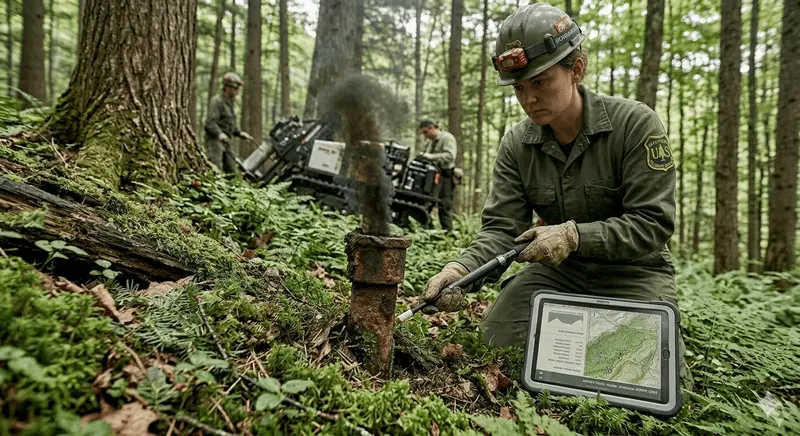
Cleaning the "Bore": A specialized, compact service rig (designed to fit between old-growth trees with minimal impact) must first "clean out" the old well. This involves fishing out rotted wooden sucker rods or rusted iron tools dropped by wildcatters a century ago.
-
The Cement Sandwich: Crews use a calculated "plugging schedule." They pump high-density, sulfate-resistant cement into specific geological zones—typically the "freshwater protection zone" and the "hydrocarbon zone"—creating a permanent, multi-layered seal that is pressure-tested to 21st-century standards.
2. The Geometry of the "Plug"
Plugging a 19th-century well isn't as simple as pouring cement down a hole. These are fragile, pressurized systems that must be surgically sealed to prevent groundwater contamination.
3. Modern Mitigation: The "Bio-Seal"
In some cases, the soil around a "Ghost Well" has been saturated with brine or crude oil for decades. Here, the "Subsurface Pulse" involves Bioremediation.
After the iron pipe is cut and capped below the frost line, specialists introduce oil-eating microbes and nutrient-rich bio-char into the soil. This accelerates the forest’s natural ability to "digest" the historic spill, allowing the native ferns and hardwoods to finally reclaim the site.
4. Why the "Pulse" Matters
Methane is over 25 times more potent than carbon dioxide at trapping heat in the atmosphere. By finding and killing these "Ghost Wells," the ANF transition from a source of carbon leakage back into a pure carbon sink. It is the ultimate form of industrial atonement—using high-tech sensors to heal the scars of the first oil boom.