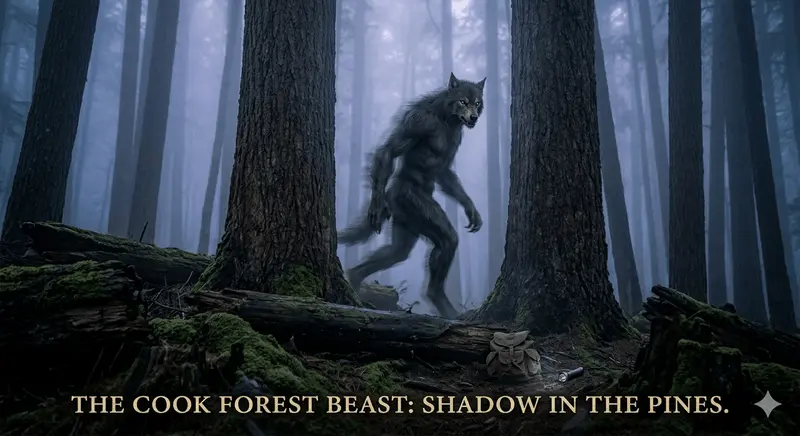
While the Kinzua region is defined by its deep valleys and submerged history, its southern neighbor—Cook Forest State Park—holds a darker, more predatory secret. Known for its "Cathedral Forest" of towering, ancient white pines, the area has long been the epicenter of sightings that defy the standard Bigfoot narrative.
In the Pennsylvania Wilds, there is a distinct brand of cryptid lore that describes something far more lean, agile, and terrifying: the "Canine-Hominid" of the old-growth.
The 1940s: A Decade of Dread
Though stories of "wild men" had circulated since the logging era, the lore reached a fever pitch in the 1940s. During this decade, repeated reports emerged from hunters and local residents describing a "hairy, upright creature" that moved through the dense pines with a speed that no bear or human could match.
Unlike the bulky, ape-like descriptions typical of Bigfoot sightings, these witnesses described a creature with a pronounced, canine-like snout, pointed ears, and long, powerful limbs. It was frequently seen "shimmering" through the shadows—a term locals used to describe its ability to move so fast it almost seemed to blur against the vertical lines of the pines.
More Than a Bigfoot: The "Shunka Warakin" Connection
Cryptozoologists often distinguish the Cook Forest sightings from the standard Sasquatch by comparing them to the Shunka Warakin—an Indigenous term meaning "carrying off dogs." This creature is described as a high-backed, wolf-like beast that walks comfortably on two legs.
In the localized lore of the Cook Forest/ANF corridor, these "werewolves" are characterized by:
-
The Vertical Bound: Witnesses claim the creature can leap incredible distances, navigating the steep, rocky terrain of the Clarion River valley as if gravity were an afterthought.
-
The "Hollow" Howl: Unlike the deep, chest-vibrating growl of a Bigfoot, the Cook Forest beast is said to emit a high-pitched, mechanical-sounding yip or howl that echoes through the old-growth like a siren.
-
Canine Features: Repeated mentions of a "wolf-face" on a tall, athletic human-like frame have led some to categorize this as the Pennsylvania Dogman, a cryptid that has seen a resurgence in modern sightings across the Appalachian plateau.
Why the Old-Growth?
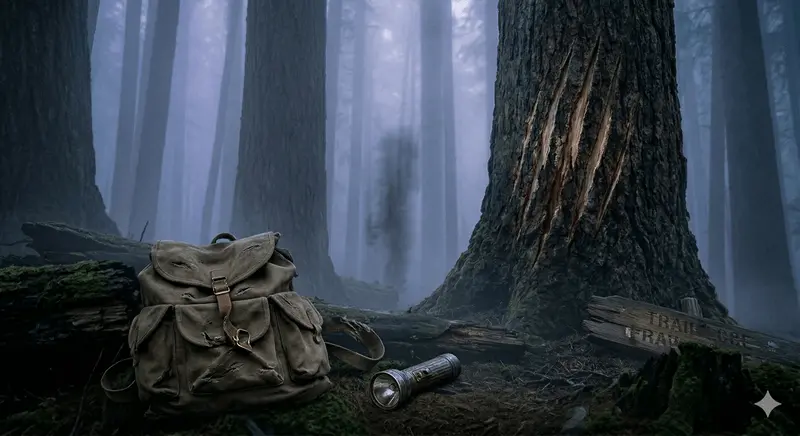
Cook Forest contains some of the only remaining virgin timber in Pennsylvania. The lore suggests that these ancient trees—some over 350 years old—provide a unique sanctuary for a creature that predates modern settlement. The "Cathedral Forest" creates a specific environment of deep silence and massive trunk diameters, perfect for an apex predator that relies on stealth and camouflage.
The Bleeding Border
While Cook Forest is the "home base" for these stories, the lore frequently "bleeds" north into the main block of the Allegheny National Forest. The interconnected trail systems and continuous forest cover mean that a creature sighted in the pines of Cook Forest one night could easily be stalking the ridges of the Kinzua region by the next.
A Modern Mystery
To this day, hikers in the more remote sections of the park report the sensation of being watched by something high up on the ridges. Whether it’s a misidentified black bear, a lingering memory of the long-extinct eastern wolf, or a truly unidentified canine-hominid, the Werewolves of Cook Forest remain one of the most chilling chapters in the mythology of the Pennsylvania Wilds.