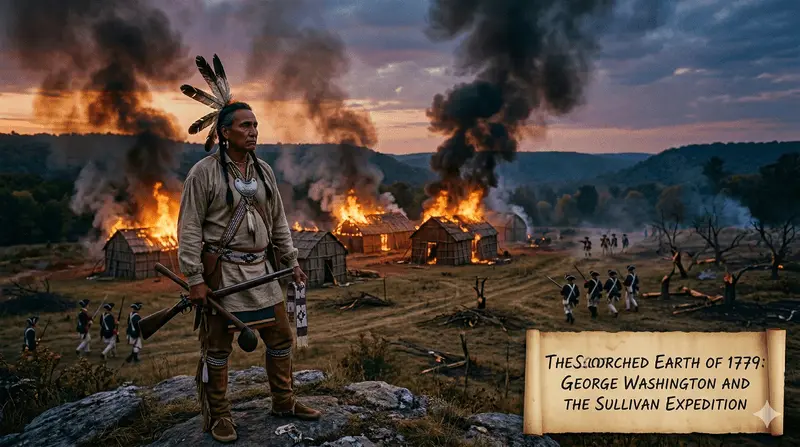
To the casual hiker traversing the lush, hemlock-shaded trails of the Allegheny National Forest, the landscape feels like an ancient, untouched wilderness. But beneath the leaf litter and the moss-covered stones of Northwestern Pennsylvania lies the scar of a foundational American trauma. In 1779, this region was the site of a systematic military campaign designed not just to win a battle, but to erase a civilization. To the Seneca Nation, this was the year of the Hanödaga’yas—the "Town Destroyer."
The Sullivan-Clinton Expedition was the Continental Army’s largest offensive of the Revolutionary War. While history books often focus on the tactical brilliance of the American colonies' fight for liberty, for the "Keepers of the Western Door," 1779 was the year their liberty was incinerated by order of George Washington.
The Orders of the "Town Destroyer"
By the third year of the Revolution, the Iroquois (Haudenosaunee) Confederacy was a fractured power. Most of the Six Nations, including the Seneca, had sided with the British, viewing them as the lesser of two evils in the face of aggressive colonial land-grabbing. Led by war chiefs like Cornplanter and Joseph Brant, the Seneca launched devastating raids on frontier settlements in the Wyoming and Cherry Valleys.
General George Washington’s response was clinical and absolute. He did not merely want to push the Seneca back; he wanted to eliminate their ability to exist. His orders to Major General John Sullivan were explicit:
"The immediate objects are the total destruction and devastation of their settlements... It will be essential to ruin their crops now in the ground and prevent their planting more."
Washington understood that the Seneca heartland was the "breadbasket" of the British war effort in the West. If he could burn the food, he could break the people.
The Burning of the Western Door
In the late summer of 1779, a pincer movement of three American divisions—led by Sullivan, James Clinton, and Daniel Brodhead—converged on the Seneca territory. What the soldiers found was not a primitive scattering of huts, but a sophisticated agrarian society that rivaled the productivity of the European colonies.
The journals of Sullivan’s soldiers reveal a mixture of awe and destructive zeal. They described "well-built frame houses" with stone chimneys and "vast fields of corn, the stalks of which were so high a man on horseback could not be seen."
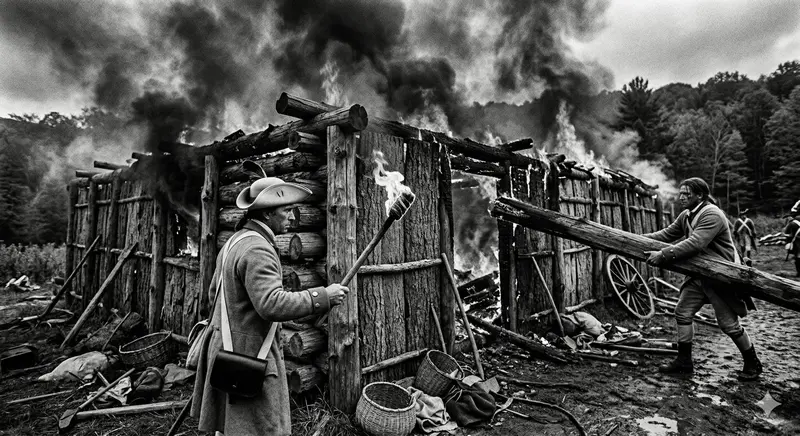
As the army moved through the Allegheny and Finger Lakes regions, they executed a "scorched-earth" policy that spared nothing:
-
Forty towns were burned to ash, including the major Seneca hubs.
-
160,000 bushels of corn were pulled from granaries and burned in massive heaps.
-
Ancient orchards of apple and peach trees—some featuring over 1,500 trees per grove—were systematically girdled and cut down to ensure the land would yield no fruit for decades.
The Winter of Hunger
The military campaign lasted only a few months, but its biological impact lasted years. Stripped of their shelter and their winter stores, thousands of Seneca men, women, and children were forced into a desperate "Death March" toward the British stronghold at Fort Niagara.
The winter of 1779–1780 turned out to be the harshest in recorded colonial history. Snow drifted five feet deep, and the mercury plummeted. In the crowded, disease-ridden camps around the fort, the Seneca died by the hundreds from scurvy, smallpox, and starvation. The "Keepers of the Western Door" were no longer the masters of the frontier; they were refugees on their own continent.
A Legacy of Rebirth
The Sullivan Expedition achieved its goal. The destruction of the Seneca towns cleared the way for a massive wave of white settlement after the war. The "Pennsylvania Desert"—the scorched remains of the Allegheny Valley—became the footprint upon which the modern United States was built.
Yet, the campaign failed to achieve its ultimate objective: the extinction of the Seneca people. Under the leadership of Chief Cornplanter, survivors eventually returned to the charred remains of their valley. They replanted the "Three Sisters" (corn, beans, and squash) and negotiated the treaties that would allow them to remain on a fragment of their original land—a fragment that would later be threatened again by the Kinzua Dam in the 20th century.
Today, the title Hanödaga’yas (Town Destroyer) remains the traditional Seneca name for the President of the United States. It is a linguistic scar, a reminder that the beauty of the Allegheny region was forged in the fires of 1779. The resilience of the Seneca Nation today is a testament to a people who, despite having their world burned to the ground, refused to let the "Western Door" stay closed forever.