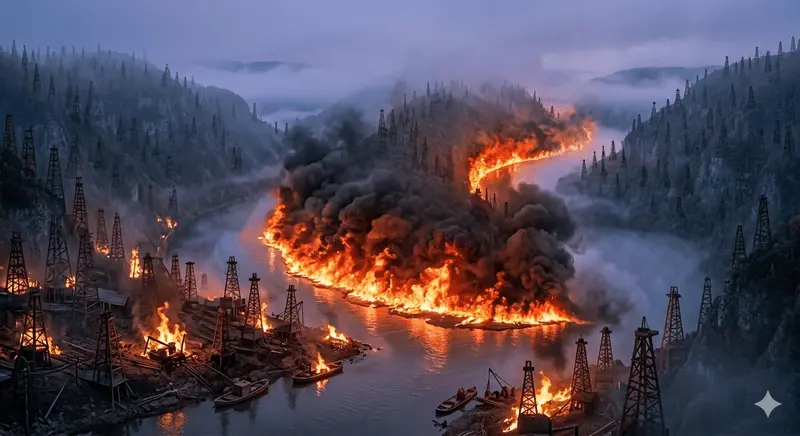
Before the Allegheny National Forest became a sanctuary of second-growth timber and deep, unglaciated valleys, it was the raw, blazing epicenter of the first global industrial energy rush. The landscapes of McKean and Warren counties—defined by ancient hemlock ridges and steep, repeating valleys—were the theater for a rapid, unbridled industrialization that fundamentally reshaped the American frontier. Long before environmental conservation took root, the unglaciated plateau was defined by oil, wooden derricks, and a catastrophic inferno that came to be known as the "River of Fire."
The Rush to the Un-glaciated Plateau
The unglaciated ANF possesses a unique geological profile; the massive ice sheets of the last Ice Age stopped just short of this plateau, leaving steep, V-shaped valleys and a subsurface rich in "rock oil." Following the historic Drake Well in 1859, a chaotic migration surged north. In the 1870s and 1880s, these remote, silent ridges were violently awakened.
This era defined unbridled industrial extraction. The visually dominant feature of this "blighted industrial scene" was the proliferation of thousands of rustic, wooden oil derricks. These spindly structures choked the horizons, covering the steep, ancient forest ridges from peak to riverbank, creating a dense, skeletal maze of timber and iron that effectively erased the natural canopy visualized in earlier regional narratives.
The Landscape of Permissive Destruction: Open-Pits and Disaster
This first oil boom occurred decades before modern safety regulations or environmental containment. Life in the Bradford Oil Field, the most productive field in the world at the time, was hazardous. The visual landscape was one of saturation: every creek, hillside, and river was coated in a black, sticky film.
The primary form of storage was the dangerous "open-pit" or circular wooden tank. Oil spilled constantly, infiltrating the complex hydrology of the unglaciated valleys. Gas explosions and well fires were so common they became part of the daily ambient background—a dangerous orange-red pulse of light illuminating the constant cool blue twilight and pervasive, moody fog that typically defines this landscape.
The Catastrophic Ignition: The Day the Allegheny Ignited
The environmental chaos reached its horrifying apex in the legendary incident known as the "River of Fire."
Folklore and historical records converge on a catastrophic day when an exceptionally large open-pit storage facility near the riverbank failed, sending thousands of barrels of raw crude cascading down a narrow, steep valley. The oil hit the Allegheny River, a waterway that typically meanders peacefully through the misty, rugged gorge visualized in previous accounts.
It is believed that this vast, floating slick was ignited either by a sparks from a passing logging train (similar to the industry seen in earlier regional history) or by a well fire that spread. The results were instantaneous and apocalyptic. The entire river surface, choked with oil, became a single, blazing inferno.
The Blazing Inferno and the Inland Inferno Tidal Wave
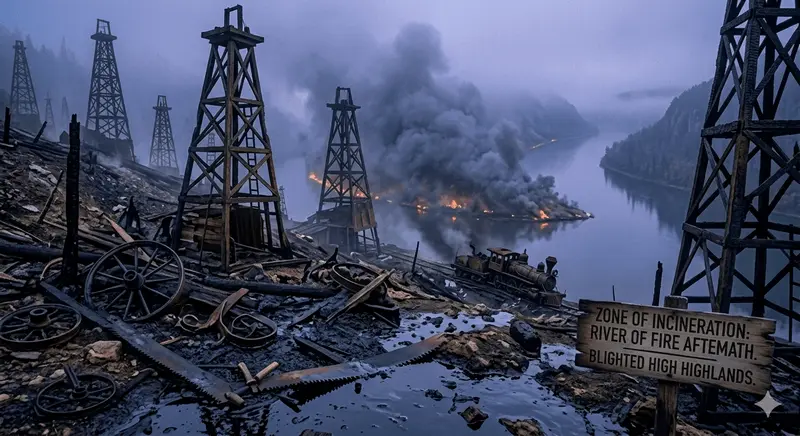
This was not a simple river fire; it was a physical moving inferno tidal wave of fire that surged downstream, following the exact curves of the misty, unglaciated gorge shown in regional visuals. The violent, chaotic orange-red glow of the massive oil fire blazing directly on the river was the only light source, casting terrifying shadows against the ancient, blighted ridges defined by thousands of wooden derricks.
Witnesses described the event as biblical. The heat was so intense that it ignited the wooden derricks lining the riverbanks before the main wall of fire even arrived. The inferno incinerated logging camps, river towns, and entire miles of forest that lined the narrow valley. The unglaciated gorge, usually a sound chamber for echoes and whispers, was filled with the crushing roar of the blazing river.
A Blighted Industrial Memory
The "River of Fire" stands as a foundational tragedy of the unglaciated ANF—a moment of catastrophic industrial hubris that contrasts sharply with the spiritual hauntings, submerged secrets, and environmental management that define the region today. While the forests eventually regrew and the river healed, this blighted history ensures that the memory of unbridled industrialization remains etched into the ancient topography of the Pennsylvania Wilds.