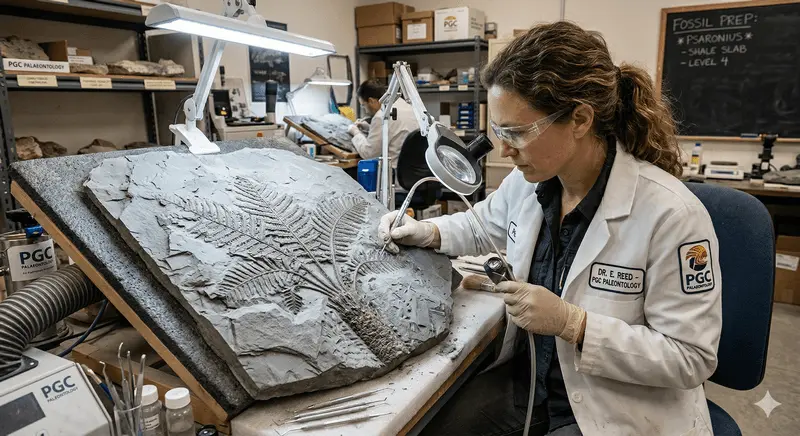
While standard geological layers define the Allegheny Plateau (as seen in our survey of subsurface geometry), the true magic of its Deep Time Garden is the preservation of life in 3D. The standard "Sedimentary Layer Cake" (sandstone, shale, conglomerate) usually compresses fossils into flat, two-dimensional carbon films. But here, unusual circumstances captured the structure of ancient forests.
To find these botanical treasures, we must travel 300 million years back to the Carboniferous Period—the time of the "Coal Forests."
1. The Undisturbed Vault: A Gentle Uplift
The key to the Plateau’s paleobotanical richness is gentle deformation. While the Appalachian Mountains to the east were violently crushed and folded, the layers beneath the ANF were only softly warped into broad, stable arches (the "Anticline" geometry).
This meant that when ancient plants were buried in river silt and mud, they weren't pulverized. The surrounding sediment (often fine grey shale) hardened around the plant material. The organic material may have decayed, but it left behind a perfect three-dimensional mold of its complex structure.
2. The Great Tree Ferns: Forests of Giant Grass
The dominant trees of this ancient forest were not oaks or hemlocks, but massive, primitive vascular plants related to modern ferns and clubmosses.
-
Lepidodendron (Scale Trees): These bizarre, non-woody trees grew up to 100 feet tall and looked like giant sticks covered in green scales. The scales are actually diamond-shaped leaf scars.
-
Sigillaria: Often confused with Lepidodendron, these trees have leaf scars arranged in neat, vertical rows, resembling an armored column.
-
Giant Horsetails: Related to the small "Scouring Rush" found in modern wetlands, ancient Calamites were towering, segmented rushes that could grow 30 feet high in dense, bamboo-like groves.
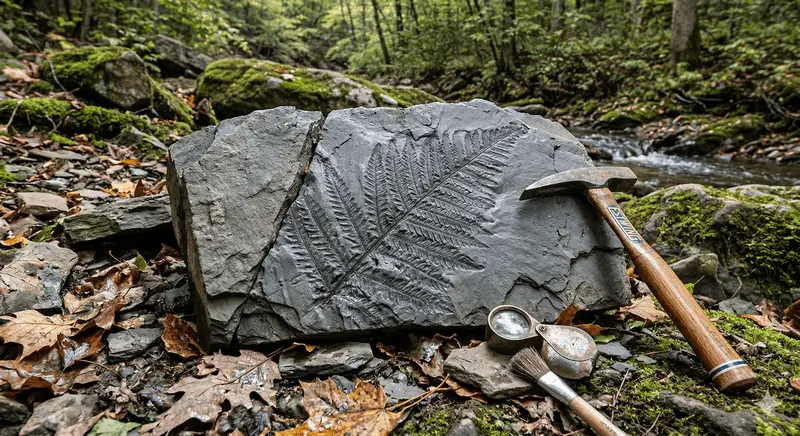
3. Precision Paleobotany: The "Air-Pick" Investigation
Modern paleobotany in the ANF is not done with a pickaxe, but with surgery-grade precision. Teams often process shale slabs found right where ancient rivers dissected the plateau.
Instead of splitting a rock and hoping for luck, researchers use micro-jackhammers and specialized, precise abrasive air-picks (like miniature sandblasters) to carefully erode the surrounding grey shale grain by grain. This technique "liberates" the three-dimensional form of the fossil, revealing delicate features like seed cones and the finest vein patterns that would have been crushed in any other geological environment.
4. Direct Continuity: The Living Link
The most visually striking aspect of a Carboniferous find is the immediate recognition. The grey shale might reveal a detailed frond of Pecopteris (a type of seed fern). A quick glance down at the modern forest floor reveals a direct descendant: the delicate, subdivided fronds of a Maidenhair Fern or Lady Fern.
By using technology to "unearth" these ancient botanical structures, the PGC paleontological team isn't just collecting dust; they are providing a direct visual map of the Plateau’s 300-million-year botanical journey, confirming that while the industrial boom came and went, the geometry of the ferns remains eternal.