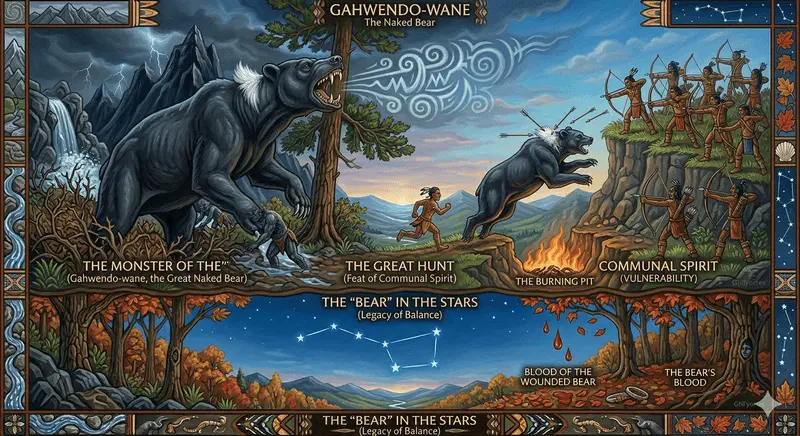
In the deep, ancient forests of the Haudenosaunee, there is a name spoken with a mixture of dread and profound respect: Gahwendo-wane, the Great Naked Bear.
While the Jo-ga-oh represent the hidden stewards of nature, the Naked Bear represents its most primal, unstoppable ferocity. It is a creature of legend—a monstrous, hairless predator that once haunted the valleys, challenging the survival of the First People and serving as a reminder that the wild holds powers far beyond human control.
Physicality: The Monster of the North
The Naked Bear is not merely a bear without fur; it is a supernatural titan. Traditional descriptions paint a portrait of a beast designed for absolute dominance.
-
Size and Stature: It is said to be many times larger than the largest grizzly. When it stood on its hind legs, its head reached above the lower branches of the great pines.
-
The "Naked" Skin: Its most striking feature is its smooth, tough, and completely hairless skin. This skin was said to be as thick as a warrior’s shield and nearly impenetrable to flint-tipped arrows or bone spears.
-
The White Crest: The only hair on its entire body was a small, singular tuft of pure white fur located on the back of its neck—the creature’s only physical vulnerability.
-
The Teeth and Claws: Its teeth were described as long, serrated ivory daggers, and its tracks were so large they could hold enough rainwater to drown a small dog.
-
The Burning Pit: They dug a massive trench and filled it with brush and oil.
-
The Lure: A brave runner acted as bait, leading the creature on a chase through the narrowest ravines.
-
The Vulnerability: As the bear leaped over the burning pit, the warriors—positioned on the cliffs above—launched a synchronized volley of arrows specifically targeting the white tuft of fur on its neck.
Behavior: The Man-Eater of the "Great Steeps"
Unlike the common black bear, which generally avoids human contact, the Gahwendo-wane was an active hunter of men. It was a creature of singular focus and terrifying speed.
The Unstoppable Pursuit Legend says that once a Naked Bear picked up a human scent, it would never stop. It could scent a village from miles away, and its thick skin allowed it to crash through the densest thornbushes and briars—the very "great steeps" created by Flint—without a single scratch. Because it lacked fur, it was incredibly agile and moved with a silent, ghostly grace that belied its massive size.
The "Bellow of Thunder" The creature did not growl; it issued a rhythmic, booming roar that shook the earth. Many stories equate its voice to the rolling thunder of the Hino (the Thunder Beings), often confusing hunters into thinking a storm was approaching when, in reality, the predator was closing in.
The Great Hunt: The Fall of the Beast
The most famous legends regarding the Naked Bear involve the heroic efforts of the Haudenosaunee warriors to rid the land of its terror.
"To kill a Naked Bear was not a feat of strength, but a feat of communal spirit and divine favor."
The hunters realized that conventional weapons were useless against its hide. According to oral tradition, a Great Council was called to find a way to defeat the beast. Following a dream sent by the spirits, the warriors prepared a trap:
When the arrows struck that single point of vulnerability, the creature’s supernatural protection shattered. It fell into the flames, and its roar was silenced forever.
Symbolism and Modern Legacy
In Iroquois culture, the Naked Bear serves as a powerful metaphor for excess and overpowering ego. It is a creature that took more than it needed and gave nothing back to the cycle of life—a stark contrast to the balance maintained by the Twin Sons.
The "Bear" in the Stars Some traditions link the Naked Bear to the constellation of the Big Dipper (The Great Bear). It is said that the three stars of the "handle" are hunters forever chasing the Great Bear across the sky. Each autumn, when the leaves turn red, it is believed to be the blood of the wounded Naked Bear dripping down from the heavens onto the forest floor.
Today, the story of the Gahwendo-wane is told to remind us that even the most "impenetrable" forces have a weakness, and that when a community stands together against a singular terror, even a monster of the "Great Steeps" can be overcome.