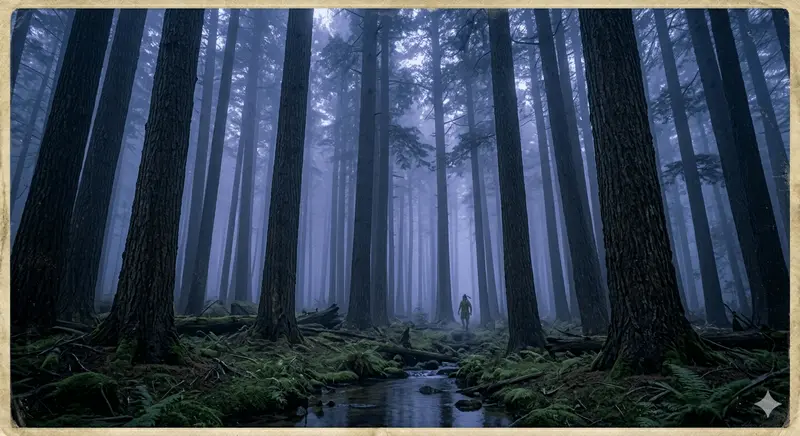
To walk through the Allegheny National Forest today is to wander through a "second-growth" landscape—a resilient, lush forest that has reclaimed the land over the last century. However, the towering hemlocks and hardwoods we see now are mere shadows of the titans that once ruled these ridges. Before the oil derricks choked the hills and before the "River of Fire" scarred the valleys, the region was defined by a singular, gold-standard resource: the Virgin White Pine.
The ecological history of Warren County is a story of total extraction, defined by a specialized and perilous industry known as the Log Drive Era. It is the reason the "Cathedral Pines" of lore are now a rarity, and it explains why the unglaciated plateau looks the way it does today.
The "Cathedral Forest": A Vanished Wilderness
In the early 19th century, the unglaciated plateau was a dark, cool, and ancient world. The white pines here were legendary—reaching heights of 200 feet with diameters so wide three men could not lock hands around them. This "Cathedral Forest" created its own microclimate, trapping the pervasive, moody fog and maintaining a deep, damp silence that echoed through the V-shaped valleys.
To the lumbermen of the 1800s, this wasn't a spiritual sanctuary; it was a harvest. The timber was perfectly straight, buoyant, and seemingly infinite.
The Specialized World of the Lumber Camp
The extraction began deep in the ridges, far from the riverbanks. During the autumn and winter months, "wood crews" established isolated, rustic lumber camps. These were hard-scrabble settlements made of raw, hand-hewn log cabins nestled among the steep slopes.
The work was seasonal and brutal. Using only crosscut saws and double-bit axes, teams of "fellers" brought the giants down. Once felled, the pines were "skidded" by teams of oxen or horses over frozen ground to the banks of the Allegheny River and its tributaries, like Tionesta Creek. By late winter, the riverbanks were lined with millions of board-feet of timber, stacked in massive, precarious decks waiting for the spring thaw.
The Log Drive: The River Becomes a Mosaic
The true drama of the era began with the Spring Freshet. As the snow melted and the river surged—the same natural force that later fueled the Great Ice Jams—the logs were "splashed" into the water.
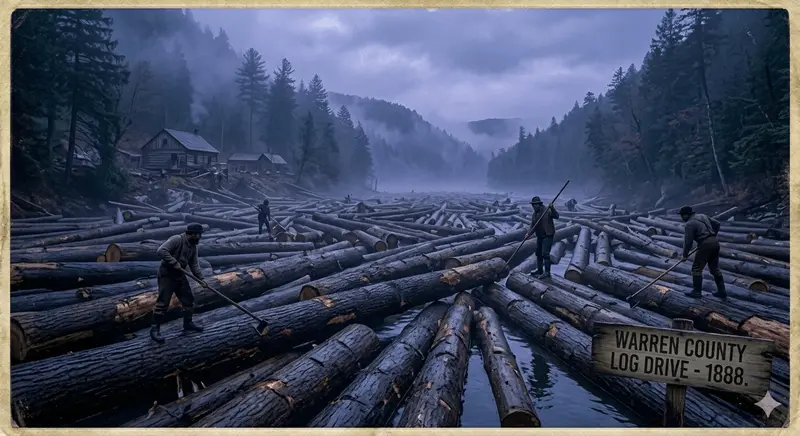
This was the Log Drive. The Allegheny River was transformed from a misty, meandering waterway into a tight, overlapping mosaic of thousands of massive, felled pine logs moving downstream. It was a chaotic, grinding mass of timber that completely choked the river from bank to bank.
The men who managed this chaos were "river pigs"—specialized workers who wore caulked (spiked) boots to balance on the spinning logs. Their job was to keep the timber moving and, most importantly, to prevent the Log Jam. If a single log "snagged" on a rock or a bend in the unglaciated gorge, the entire drive could grind to a halt, creating a mountain of timber that could only be broken by the strategic use of black powder.
From Warren to the World
These drives defined the river traffic of the 19th century. The logs eventually made their way to the massive mills in Warren and, ultimately, to the booming shipyards and construction sites of Pittsburgh and beyond. The white pine of the Allegheny built the cities of the East and the masts of the American Navy.
The Ecological Legacy
By the early 20th century, the "inexhaustible" forest was gone. The lumber camps were abandoned, leaving only rotting foundations among the second-growth saplings. The removal of the virgin canopy fundamentally changed the region's ecology:
-
Soil Erosion: Without the massive root systems of the white pines, the steep unglaciated ridges suffered significant topsoil loss.
-
Stream Temperature: The loss of shade caused water temperatures to rise, forever altering the habitat for native brook trout.
-
Forest Composition: The pines were replaced by the "Black Cherry and Maple" forest we see today, which thrives in the sun-drenched clearings the loggers left behind.
The Log Drive Era was a period of monumental human effort and environmental sacrifice. It serves as the transition point between the ancient, spiritual wilderness of Seneca lore and the managed, industrial landscape that eventually became the Allegheny National Forest.