Any camper who has spent an evening near the Kinzua Reservoir or hiked the North Country Trail in late spring knows the truth: the real apex predator of the Allegheny National Forest isn't the black bear or the elusive timber rattle snake. It is the biting gnat, commonly known as the "no-see-um."
These microscopic terrors define the specific seasonal misery of living in the ANF, often proving far more relentless and agonizing than any mosquito. In the folklore of the region, this unique plague is not an ecological accident. According to ancient Seneca legend, the gnats are the literal, living curse of a defeated evil.
The Context: A Localized Plague
The gnats of the northern ANF are legendary for their intensity. Invisible to the naked eye, they strike in clouds, leaving burning, itchy welts that can last for days. They are a localized phenomenon, seemingly drawn to the specific humidity and geography of the Kinzua region. This story provides a necessary mythological explanation for why such small creatures possess such disproportionate, focused malice.
The Story: The Battle in the Hills
As the lore goes, long before European settlement, the Haudenosaunee (Iroquois Confederacy) was terrorized by a powerful and corrupt sorcerer. This sorcerer used dark magic to transform his physical shape, manipulate the weather, and inflict wasting diseases upon the people. He was a creature of pure malice.
Realizing the threat could not be ignored, the Seneca Nation tasked a young, pure-hearted warrior with a sacred quest: find the sorcerer and destroy him. This was not a simple hunt. The resulting multi-day battle spanned the complex ridges and deep, unglaciated valleys that now make up the heart of the ANF. The sorcerer used every dark art at his disposal, turning the very forest against the warrior. Ultimately, however, purity of spirit triumphed over dark magic. In a final, legendary duel, the warrior defeated the sorcerer, striking him down in the very landscape he had corrupted.
The Vengeful End: Ashes of Malice
The people rejoiced at the news, but the Seneca elders knew that an evil that powerful would not simply vanish in death. Because the sorcerer’s body was so thoroughly corrupted by his own dark magic, the conventional rites of passage could not be used. It was decided that his remains had to be destroyed completely, purifed by fire so his spirit could not reanimate his flesh.
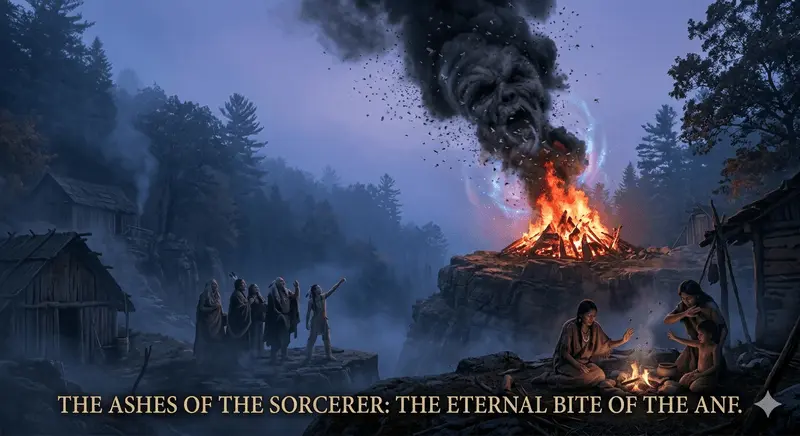
The people built a massive pyre using sacred woods and burned the sorcerer's body. However, even as the greedy flames consumed his physical form, the sorcerer’s spirit refused to yield. In a final act of supernatural defiance, he used his last breath to hurl a terrifying curse at the gathered crowd.
He shouted: "You may burn my bones, but my spirit will never die! I will turn into a million small things, and I will keep biting you forever!"
The Outcome: The Eternal Curse
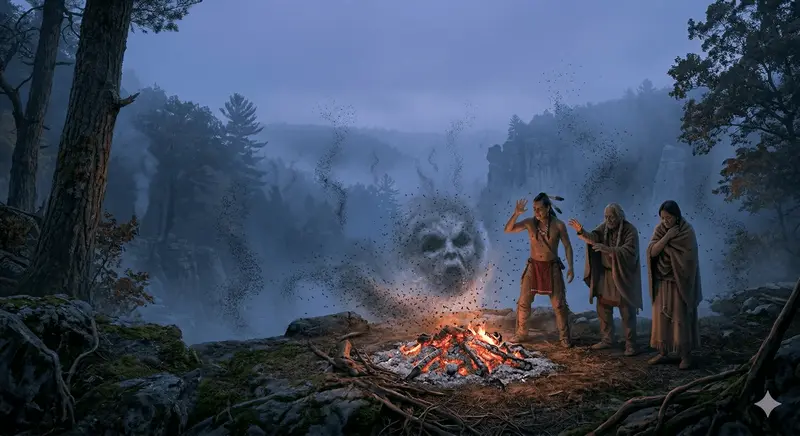
As the sorcerer’s body was reduced to dust, a strange thing happened. The thick, black plumes of ash rising from the massive pyre did not fall back to earth as soot. Instead, as each gray flake cooled, it was transformed. The ash didn't land; it took flight.
Each particle of the burned sorcerer became a tiny, nearly invisible, black biting gnat. The ancient folklore insists that this is why the gnats of the ANF are so agonizing: they are the literal, vengeful ashes of defeated evil, forever swarming the landscape where they fell, fulfilling the sorcerer’s final curse with an eternal, burning bite.