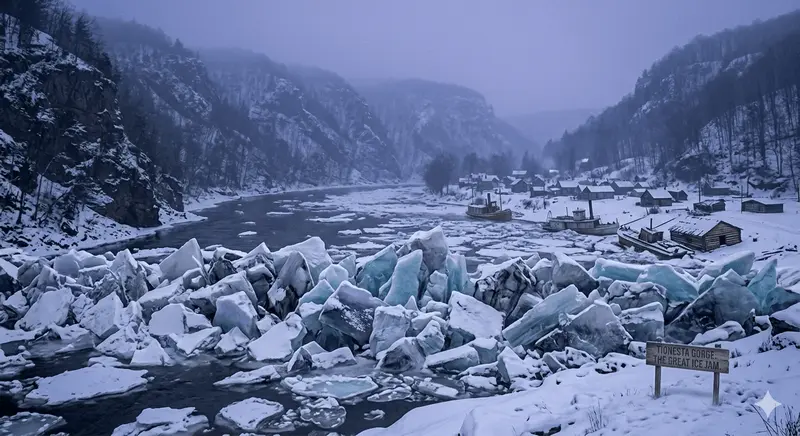
In the annals of environmental disasters specific to the Pennsylvania Wilds, few events match the sheer, crushing power of the great ice jams that historically plagued the upper Allegheny River. While the region is now managed by a system of flood-control dams, in the early 20th century, the communities nestled in the deep, unglaciated valleys lived in seasonal dread of the river's frozen fury. The most legendary of these events occurred during the brutal winters of 1918 and 1936, centering on the town of Tionesta, where the geography conspired to create a catastrophic, artificial ice-dam.
The Perfect Frozen Storm: Extreme Cold and a Sudden Thaw
The mechanism for an ice jam of this magnitude requires a specific, volatile sequence of weather events. In both 1918 and 1936, the region experienced prolonged, deep-freeze conditions. The Allegheny River, which curves tightly through the narrow, V-shaped valleys of the unglaciated plateau, froze solid. This was not a thin sheet of surface ice; it was a massive, subterranean blue-white shield, often exceeding six feet in thickness.
The crisis was triggered when an intense, deep-freeze pattern was broken by a sudden, dramatic spike in temperature—a rapid "January Thaw." This abrupt warming, often accompanied by heavy rain, caused a massive, synchronous snowmelt across the entire unglaciated watershed.
The Crushing Chaos: The Valley Becomes an Ice Trap
As the rapidly rising water surged beneath the frozen river, it applied immense upward pressure. The river did not melt; it exploded. The sound, described by contemporary observers as a "continuous, rolling artillery fire," signaled the breaking of the ice sheet into jagged, multi-ton blocks.
The narrow, twisting geometry of the unglaciated Allegheny gorge now became a lethal trap. At Tionesta, a natural bottleneck in the river, these massive ice floes collided, stacked, and turned upright. The resulting ice jam was a chaotic, fractured wall. It was not a neat barrier; it was a mountain range of splintered, multi-colored ice blocks—jagged whites, cool indigos, and translucent pale blues—that stacked two stories high, completely filling the deep gorge from bank to bank.
This wall effectively formed an impassable, artificial dam. The river, still surging from the snowmelt and rain, was instantly trapped. It backed up for miles into the surrounding narrow valleys. The resulting flood was uniquely devastating: the rising water was filled with the jagged, moving ice blocks, which acted as battering rams, physically crushing everything in their path. Houses were lifted off their foundations, bridges were snapped, and railroad tracks were twisted like wire.
The Catastrophic Burst: The Inland Tidal Wave
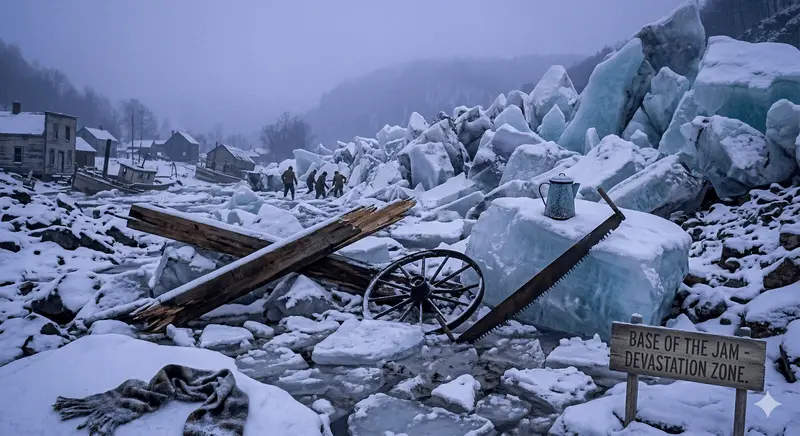
The true environmental nightmare occurred when the pressure finally became too great. As the ice dam weakened at its base, the "burst" was instantaneous and catastrophic. A titanic wall of water and fractured ice, described by witnesses as an inland tidal wave, surged down the valley with unstoppable force.
This sudden release obliterated the communities downstream, including Tionesta. The force of the moving ice and water stripped the topsoil from the river islands and fundamentally reshaped the unglaciated riverbanks. It was a level of environmental chaos that the modern, managed Allegheny River system, governed by the Kinzua and Tionesta dams, was specifically built to prevent.
A Frozen Memory
Today, the Great Tionesta Ice Jams are fading into distant memory, preserved only in local historical archives and sepia-toned photographs. They serve as a stark reminder of the volatile, untamed power of the Allegheny River when confined within the narrow sound chambers of its ancient, unglaciated valleys. They were a unique and recurring tragedy, defining the specific misery of early 20th-century frontier life in the Pennsylvania Wilds.