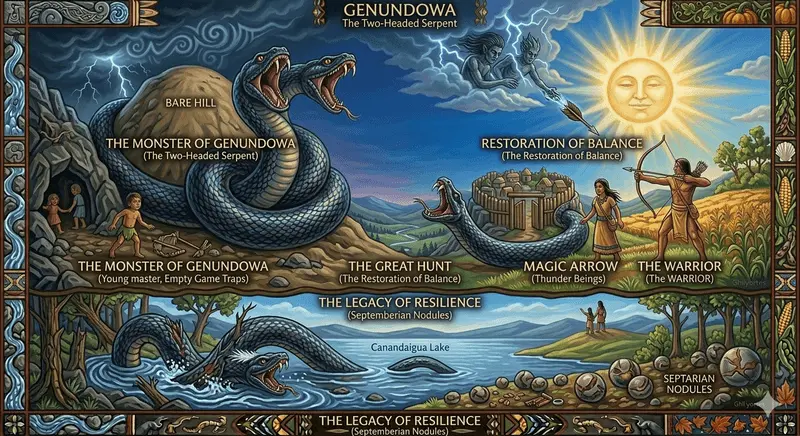
In the rolling hills of the Finger Lakes region in New York, overlooking the waters of Canandaigua Lake, stands Genundowa, or "Bare Hill." This landmark, characterized by its rounded shape and distinct lack of trees, is the visual setting for one of the most significant origin stories of the Seneca (Onöndowa’ga:), the "People of the Great Hill."
Like the creation story of the Twin Sons and the legend of the Naked Bear, the saga of the Great Serpent (sometimes called the "Lake Monster") explores a central Haudenosaunee tenet: that life is defined by how the forces of creation and chaos are balanced. It is a defining story of national identity and resilience.
The Origin from the Earth
The legend begins not with the monster, but with the birth of a people. According to Seneca oral tradition, long ago, Genundowa split open, and from its depths, the ancestors of the Seneca emerged. They were a peaceful agricultural people who built a fortified village on the very hill that birthed them, living in abundance and harmony.
This period of peace forms the first half of the duality—the "Sky-Holder" domain of order and growth.
The Creation of the Monster
The central conflict is set in motion by an act that is, in itself, innocent. A Seneca boy, wandering the forests Flint created, discovers a small, unusual two-headed snake. He is captivated by its iridescent scales and takes it home as a pet. This is the moment a chaotic force (Flint's legacy) is invited into the heart of human order.
For a time, the creature is manageable. It lives in a box, and the boy easily finds enough small game to feed its two hungry mouths. However, just like the Naked Bear grew monstrous, so too does this serpent. It begins to grow exponentially, eventually outgrowing its box and then the longhouse.
The Monster of Excess
The Great Serpent quickly becomes an insatiable threat to the entire ecosystem, demanding more than it needs to survive:
-
The Depletion of Game: As the serpent’s size increases, the boy, and then the whole village, can no longer find enough deer, bear, or waterfowl to satisfy it. The forest becomes a barren place.
-
The Consumption of Children: When the supply of animals fails, the monster begins to view the very village that nurtured it as a prey source. Small children begin to disappear near its lair.
The Encirclement of Genundowa
The legend reaches its terrifying apex when the fully grown serpent encircles Bare Hill. It is described as colossal, its body a scaly wall that wraps around the entire fortified village. Its two massive, fanged heads rests right at the village's only wooden gate, blocking all escape and ensuring that any Seneca who steps outside is instantly devoured. The people are trapped, and their survival is pushed to the edge.
This is the manifestation of Flint's legacy: total entrapment and impending desolation.
The Fatal Volley: The Restoration of Balance
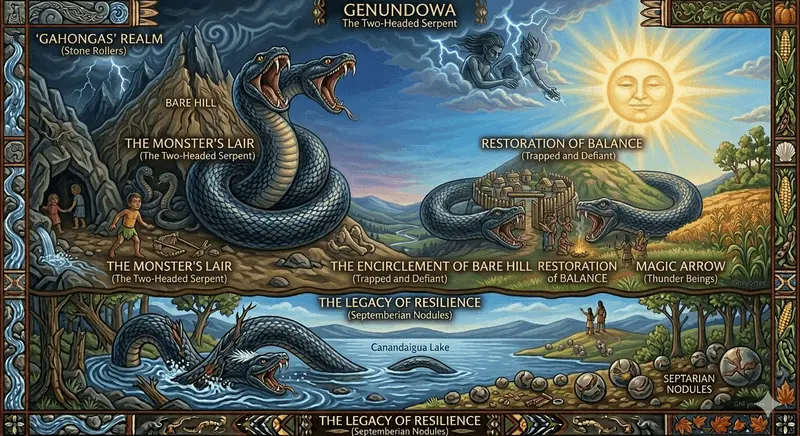
When hope is nearly lost, only one young woman and her brother remain. Following the repeating pattern seen in the Naked Bear legend, standard weapons and strength are useless. The warrior receives a dream sent by the Thunder Beings (Hino) or other powerful spirits, instructing him to create a unique magic arrow.
This arrow possesses the specific charm needed to breach the serpent's magical defenses. Traditional versions say:
-
The Fletching: The arrow is fletched not with bird feathers, but with locks of his sister's hair (representing familial unity and sacrificial love).
-
The Tip: The tip is made of a rare piece of flint, touched by a celestial force.
The warrior takes his single magic arrow and approaches the gate. The monster raises both colossal heads, ready to strike, its jaws gaping. The warrior draws his bow and releases.
The magic arrow flies true, piercing both of the monster's great red mouths simultaneously. Mortally wounded, the serpent releases its grip on the hill and writhes violently downward. It tears great pines from the soil and splits the earth as it crashes into the waters of Canandaigua Lake, its massive body creating the lake's current shape. As it dies, the monster disgorges the skulls of the Senecas it had swallowed, which instantly turn into the rounded, spherical stones found in the area today, known locally as "Septarian Nodules" or "Thunder Stones."
Symbolism and Modern Legacy
The Great Serpent of Bare Hill is more than a monster story; it is a foundational political and spiritual metaphor for the Seneca Nation.
-
Metaphor for Political Encirclement: Historically, the Seneca have viewed this myth as a literal prediction of political entrapment. During times of treaty-breaking and visual encroachment by outside settlers, the nation was seen as being "encircled by the serpent."
-
The Danger of Excess: The story serves as a stark warning about the consequences of greed and ignoring limits. A small problem, left uncontained, will eventually consume the community that feeds it.
-
The Persistence of Identity: Despite the total destruction of the original village, the two siblings survived to rebuild. The Seneca Nation today points to this legend as proof that they are a resilient people who will always emerge from hardship, having faced down the ultimate forces of chaotic excess.
Today, while some elements are relegated to visual metaphors, the site of Genundowa (Bare Hill) remains a deeply sacred site to the Seneca. The relationship between the people, the hill, the lake, and the legend of the Great Hunt (the eternal chase) ensures that the memory of the Great Serpent continues to serve as a vital reminder of the continuous need to restore and protect the balance of existence.