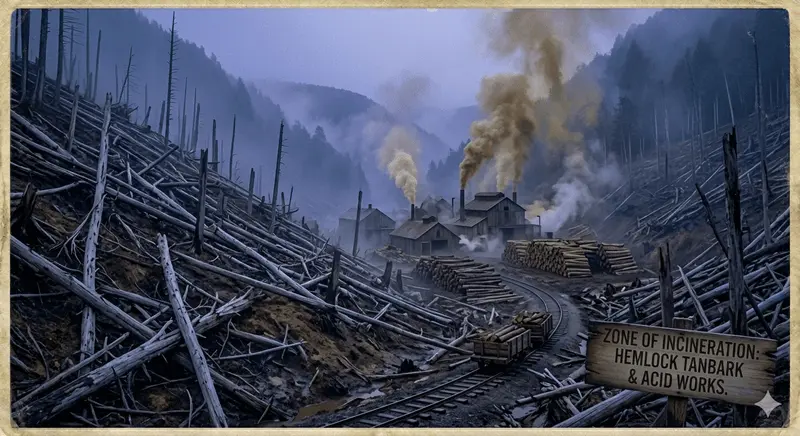
The ecological history of the Allegheny National Forest is often told in two rapid, devastating waves. The first was the great Log Drive Era, when the towering, 200-foot virgin White Pines were systematically felled and floated downstream (Image 54 and Image 52). When those giants were gone, the unglaciated plateau was not left to heal; instead, industrial extraction pivoted with alarming, toxic intensity. This second wave did not target timber; it targeted chemistry, specifically the tannin locked within the thick, reddish-brown bark of the Eastern Hemlock.
This industry, which dominated McKean and Warren counties in the late 19th and early 20th centuries, created a landscape that was, for decades, defined not by dense forest, but by a haunting phenomenon known as the "Ghost Forests" and the emergence of remote, polluting "Acid Factories."
The Chemical Harvesters: Peelers and Tannin
The driving force behind this second extraction wave was the global demand for leather. The process of tanning—turning raw animal hide into durable leather—required immense quantities of tannin. The Eastern Hemlock (Tsuga canadensis), which thrived in the cool, damp, unglaciated V-shaped valleys of the Pennsylvania Wilds (Image 22), was one of the world's richest natural sources.
This industry was distinct from traditional logging. Specialized crews, known as "Peelers," entered the remaining hemlock stands, often during the spring and summer when the sap was running and the bark could be easily removed. They did not fell the trees to transport the logs to a mill. Instead, using specialized tools called "spuds," they "girdled" and stripped the standing Hemlocks of their bark.
The target was the bark alone. The wood itself was considered secondary or even worthless for lumber at the time. The bark was stacked into cords and hauled out of the remote, misty ridges (Image 22) on narrow-gauge "logging railroads," destined for the massive tanneries in towns like Ridgway and Wilcox.
The Ghost Forest: A Landscape of Skeletal Rot
The visual legacy left by the Peelers was perhaps the most disturbing ecological transformation of the era. Across millions of acres of the unglaciated plateau, massive Hemlocks—some 300 years old—were stripped naked. They did not die immediately; they stood as living, barkless, "ghost" trunks—pale, smooth, skeletal sentinels against the cool blue-purple twilight fog and persistent misty background that usually defines this region (Image 0).
These millions of standing dead Hemlocks were left to rot. In many areas, they created a chaotic, impenetrable tangle of skeletal wood that covered entire mountainsides. This blighted landscape was not only visually haunting; it was an ecological disaster. The removal of the massive root systems and the death of the canopy led to severe erosion on the steep, unglaciated slopes. Furthermore, the massive amount of dry, decomposing wood transformed the plateau into a powder keg. For decades, catastrophic, "land-clearing" forest fires ravaged the region, consuming not only the ghost trunks but the organic soil itself, preventing the regrowth that defined the managed ANF decades later.
The Rise of the Acid Factories
As the tannins were extracted, a new, chemically intensive industry emerged to process the remaining, discarded hardwood: "Acid Factories" or "Chemical Plants." These remote industrial complexes Specialized in a process called destructive distillation. Millions of tons of beech, birch, maple, and sometimes the leftover ghost hemlock wood were loaded into air-tight "retorts" and slow-cooked, not to burn the wood, but to capture the gases and liquids.
This process yielded volatile chemicals, including:
-
Wood Alcohol (Methanol): Used as fuel and solvent.
-
Acetate of Lime/Acetic Acid: Essential in textile and photographic industries.
-
Charcoal: Used for fuel and filtration.
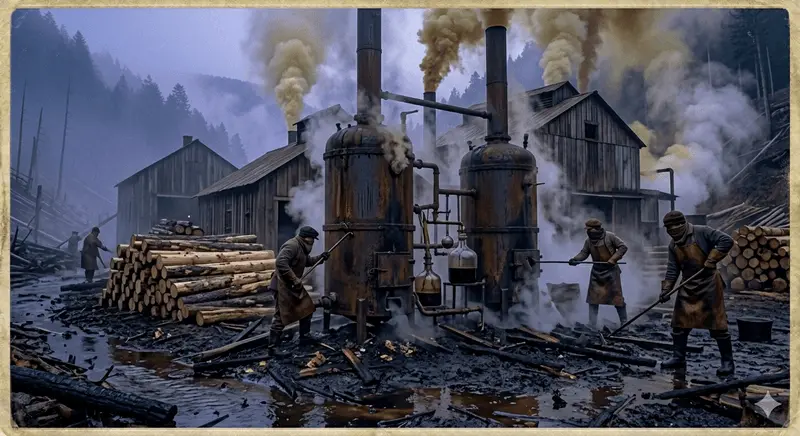
The Acid Factories were defined by a unique and polluting operational fingerprint. Located deep within the same V-shaped, unglaciated valleys that trapped the natural fog (Image 22), these rustic, industrial buildings emitted thick, acrid, often discolored smoke that mixed with the misty background. The runoff from these plants, loaded with heavy creosote and other distillation byproducts, choked the local streams and tributaries of the Allegheny River (Image 0), creating "dead zones" far more toxic than the sediment runoff of the previous logging era.
The Ecological Scar
The Acid Factories and the Hemlock Tanbark Industry represent the true industrial 'blight' of the Allegheny region. While the pine log drives were massive, they ultimately targeted a single, prized species. The Tanbark and Acid era was a total, chemically-driven industrial assault that cleared multiple species and fundamentally corrupted the region's air, soil, and water. This period explains why the modern ANF is primarily a second-growth 'Hardwood' forest (Maple, Cherry, Beech); the original Hemlock-dominated 'Cathedral Pines' microclimate (Image 52) was utterly obliterated. The unglaciated plateau we wander today is not an ancient landscape, but a resilient ecosystem that has grown back from the black, industrial, skeletal ash of the Acid Factory era.