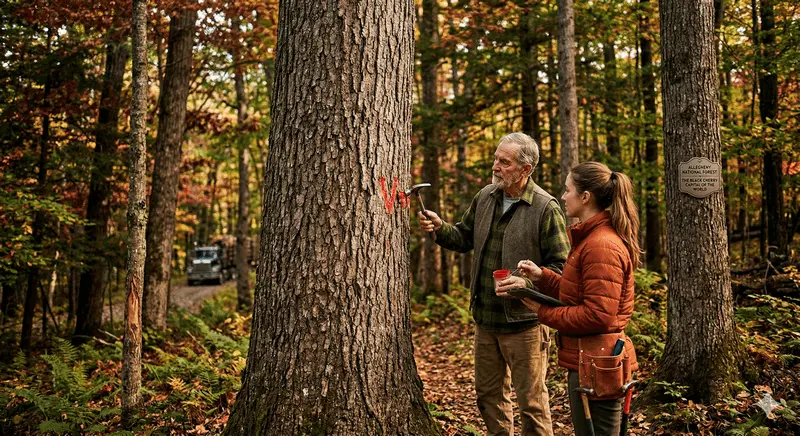
In the world of high-end woodworking, the soil of the Allegheny Plateau is legendary. While the rest of the world sees a forest, master furniture makers in Paris, Milan, and High Point see "Green Gold."
The Allegheny National Forest (ANF) and the surrounding Kinzua region are the undisputed Black Cherry Capital of the World. Here, the Prunus serotina doesn't just grow; it reaches a level of perfection found nowhere else on the planet.
1. The Anatomy of "Veneer Grade"
What makes a cherry tree from the ANF worth more than a luxury car? It comes down to texture, color, and consistency.
Because of the unique glacial soils and the specific micro-climate of the high plateau, Allegheny Black Cherry grows with a incredibly tight grain and a deep, warm heartwood that matures into a rich reddish-brown.
-
The "Gum" Factor: In other regions, cherry trees often develop "pith flecks" or mineral streaks. In the heart of the ANF, the trees are remarkably clean, producing "clear" wood that is the gold standard for veneer—paper-thin slices used to cover the surfaces of the world’s most expensive boardrooms and palaces.
-
The Growth Ring Mystery: The steady, predictable seasons of Northwestern PA allow the trees to grow at a uniform rate, creating the stable, warp-resistant lumber that craftsmen crave.
-
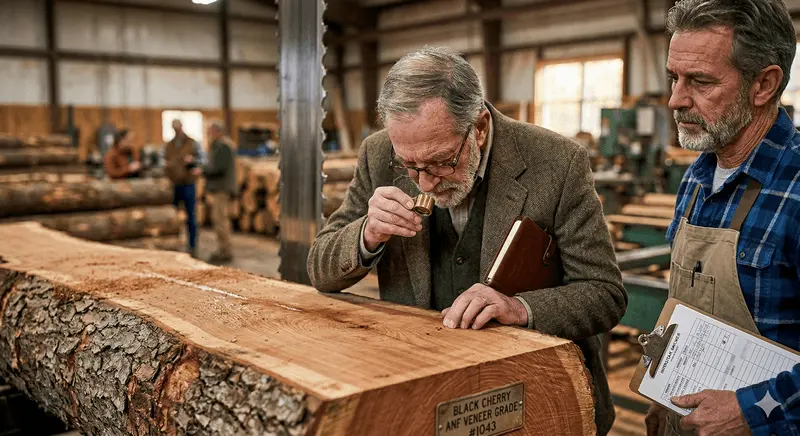
The Auction Block: Log buyers from Germany and Italy frequently travel to the mills in Kane and Marienville to hand-select "export logs."
-
Global Reach: That tree that once stood near the Kinzua Skywalk might eventually be sliced into veneer in a mill in Ohio, shipped to a furniture house in Italy, and end up as a dining table in a villa in Dubai.
-
The MOP (Mildew on Prunus): A leaf fungus that can defoliate trees and slow their growth.
-
Climate Shift: As temperatures rise, the "sweet spot" for cherry growth is slowly shifting northward, putting pressure on the southern edges of the ANF.
-
Deer Browsing: The region’s healthy deer population loves cherry seedlings. Without the protective "deer fences" seen throughout the ANF, the next generation of "Green Gold" would be eaten before it ever reached five feet tall.
2. A "Working Forest" Legacy
Unlike many National Parks that are "preserved" (left untouched), the ANF is a "managed" forest. Since its founding in 1923, it has been a laboratory for silviculture.
The foresters here use a method called even-aged management. By carefully clear-cutting small patches, they allow the sun-loving Black Cherry seedlings to race toward the canopy. This creates a cycle of renewal that has sustained the local economy for over a century. A single high-quality cherry log can fetch several thousand dollars at auction, and the revenue from these sales helps fund the very trails, campgrounds, and conservation efforts that tourists enjoy for free.
3. From Kinzua to the Louvre
The journey of an Allegheny Black Cherry tree is an international one. Once harvested, the finest logs are often purchased by international buyers.
4. The Threats to the Crown
Being the king of the forest isn't easy. The Black Cherry faces modern challenges that foresters are working overtime to solve:
Key Fact: The "Kane" Connection
The town of Kane, PA, is often called the "Black Cherry Capital" because of its historic mills and its proximity to the most productive cherry stands. If you drive through the region in late May, the air is thick with the sweet, almond-like scent of cherry blossoms—the smell of the next century’s fortune beginning to grow.