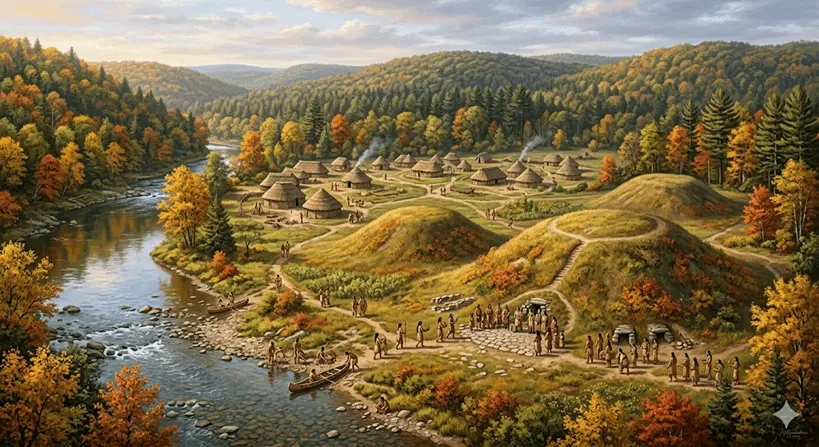
When we think of the deep history of the Kinzua Valley, our minds naturally drift to the familiar milestones carved into the landscape. We think of the engineering marvel of the Kinzua Dam, the rugged era of nineteenth-century lumbermen, or the rich, enduring legacy of the Seneca Nation and Chief Cornplanter. But if you stand on the banks of the Allegheny River just off Route 59 and look closely enough, you are standing on top of a story that is vastly older. Long before the first European axes echoed through the white pines, and centuries before the Iroquois Confederacy held sway over these hills, a mysterious, sophisticated civilization left its mark right here in our backyard.
They are known to history simply as the "Mound-builders"—a far-reaching network of Indigenous populations belonging to the Hopewell tradition. Between 200 BC and 500 AD, while the Roman Empire was rising and falling across the Atlantic, these ancient architects were busy transforming the Eastern Woodlands into a bustling web of trade, artistry, and monumental landscape design.
For generations, the earthen monuments they left behind lay hidden under the dense cover of the Warren County forest, quiet secrets of the soil. That changed in the shadow of the Great Depression. In 1941, an ambitious archaeological survey backed by the Works Progress Administration (WPA) dispatched a team to the upper Allegheny River. Led by anthropologist Edmund Snow Carpenter and archaeologist Wesley Bliss, and utilizing a dedicated field crew of Seneca citizens from the nearby reservation, the expedition uncovered a revelation just west of the old town of Kinzua: the Sugar Run Mounds.
What they excavated over those intense months was not just a handful of scattered arrowheads, but a highly structured complex. The team revealed three distinct burial mounds, the footprints of an ancient village, and a treasure trove of artifacts that permanently changed our understanding of western Pennsylvania’s pre-colonial past. The discoveries proved that the Kinzua area wasn't a remote wilderness to the ancient world—it was a vital, connected outpost on the edge of a continent-spanning empire of trade.
Racing the WPA Clock: The 1941 Excavation
The discovery of the Sugar Run site was a triumph of systematic, modern archaeology born from an era of national crisis. In the late summer of 1941, as war raged across Europe and American involvement loomed, the WPA-backed Pennsylvania Historical Commission sought to document endangered historical sites across the Commonwealth. The junction of the Allegheny River and Sugar Run Creek was selected because local farmers had long reported an unusual, low-lying rise in the cultivated fields, along with an abundance of surface artifacts turned up by the plow.
To tackle the site, project directors brought in a field crew made up entirely of Seneca men from the Allegheny Reservation. Their profound connection to the land and tireless work ethic proved invaluable. The crew laid out a precise grid of equal, numbered squares across the floodplain, painstakingly shaving away layers of earth inches at a time to read the soil strata like pages of a book.
What looked like a singular, nondescript hill from the surface was actually three distinct, overlapping mounds that had been flattened by decades of modern agriculture. Working through September and October of 1941, the crew raced against time and worsening weather. They uncovered a complex narrative of human activity, identifying sixty-two individual burials across the three mound units. However, the clock ultimately ran out. On December 7, 1941, the attack on Pearl Harbor instantly shifted the nation's priorities. The excavation ground to a sudden halt as Bliss, Carpenter, and many members of the crew left the valley to join the war effort, leaving behind a site that had only just begun to yield its secrets.
Who Were the Hopewellian Peoples?
To understand the people who built the Sugar Run Mounds, it helps to dispel a common myth: "Hopewell" was not a single tribe or a unified political empire. Instead, archaeologists use the term to describe a widespread cultural phenomenon—often called the Hopewell Interaction Sphere—that flourished across the eastern half of North America. Centered primarily in the Ohio River Valley, this brilliant cultural tradition was bound together by shared religious beliefs, distinct artistic styles, and a massive, continental network of trade routes.
[Rocky Mountains] ---> Obsidian \
[Gulf of Mexico]  ---> Shells   \

[Appalachians]    ---> Mica     -----> [Hopewell Hubs (Ohio / Kinzua)]

[Great Lakes]     ---> Copper   /

[Flint Ridge]     ---> Chert   /
The Hopewellian people represented a unique middle ground in human history. They were not nomadic wanderers, nor were they fully urban farmers dependent on corn. Instead, they lived in small, scattered villages along rich river bottomlands, practicing a gentle mix of hunting, fishing, gathering native nuts, and cultivating early domesticated plants like goosefoot and sunflowers.
What truly set them apart was their obsession with geometry, astronomy, and honoring the dead. They were master engineers of the earth, constructing sprawling ceremonial enclosures, massive earthen walls, and burial mounds aligned precisely with the movements of the moon and sun. The upper Allegheny Valley served as the northeastern frontier of this tradition, a designated region where local populations adopted Hopewellian customs, blending them with their own mountain lifestyles.
Inside the Mounds: The Artifacts of Sugar Run
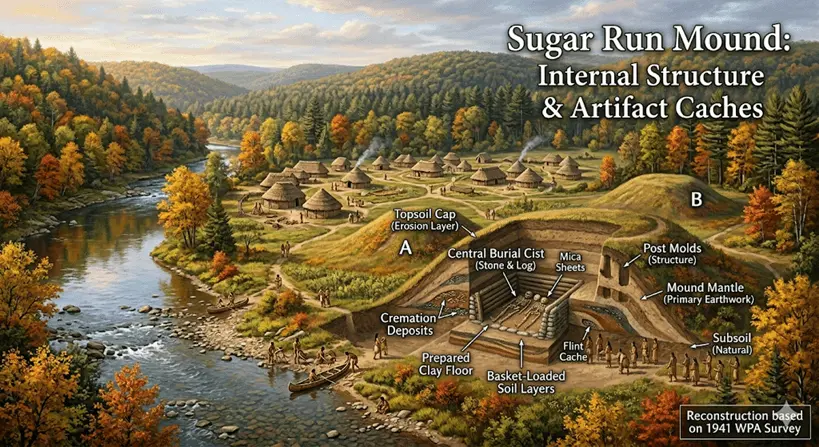
The architectural design uncovered within the Sugar Run complex reveals that these mounds were not simple, hurried graves. They were sacred spaces constructed in meticulous stages over many decades, likely serving as focal points for periodic "world renewal" ceremonies meant to restore balance to the cosmos.
Mound Unit 1, the oldest of the structures, began as a prepared, level ceremonial floor of clay. The excavation revealed three stone-lined crypts, or cists, built from local river cobbles and flat stone slabs. Surrounding these crypts were carefully laid pavements of smooth river stones. Within the central stone cists, archaeologists discovered two exceptionally well-preserved skeletons. Beneath the skull of one individual lay a cache of fifty-three finely chipped stone blades; near the feet lay brilliant deposits of red and yellow ochre pigments, a polished stone gorget (a ceremonial throat gorget or pendant), and a large, shimmering sheet of raw mica.
Scattered throughout the surrounding earth were ten cremated burials, containing small fragments of burned human bone. Deposited alongside these remains were breathtaking exotic goods that highlight the sheer reach of the Hopewell trading network:
-
Appalachian Mica: Translucent sheets of mineral glass that were intricately cut into mirrors or shimmering ornaments.
-
Galena Crystals: Heavy, metallic lumps of crystal lead ore mined from distant deposits in the Mississippi Valley.
-
Flint Ridge Chalcedony: Highly prized, colorful gem-like flint imported from central Ohio to make ultra-sharp tools and ceremonial knives.
-
Native Copper & Marine Shells: Cold-hammered copper ornaments from the shores of Lake Superior and weathered conch shells pulled from the warm waters of the Gulf of Mexico.
The presence of these materials right here in Warren County is staggering. It means that 1,800 years ago, local residents were actively trading with travelers who had journeyed thousands of miles across rivers and ancient trails to exchange western Pennsylvania's resources for the treasures of the continent.
The Legacy of the Invisible Footprints
Today, if you look out across the waters near the Allegheny Reservoir or hike the surrounding terraces, the Sugar Run Mounds are invisible to the naked eye. The completion of the Kinzua Dam project in 1965 permanently altered the geography of the valley, and the waters of the reservoir now cover much of the floodplains where the ancient village and its sacred monuments once stood.
Yet, the legacy of the Sugar Run site remains a crucial anchor for our community’s historical identity. It reminds us that the deep woods and winding waters we enjoy today are not a pristine, untouched wilderness, but a deeply storied landscape. Millennia before the first European pioneers arrived, the Kinzua Valley was a place of spiritual power, artistic mastery, and vibrant human connection. The ancient architects of Sugar Run left their footprints deep in our soil, offering a humbling, timeless reminder that we are merely the latest chapter in a spectacular, multi-thousand-year human journey along the Allegheny River.