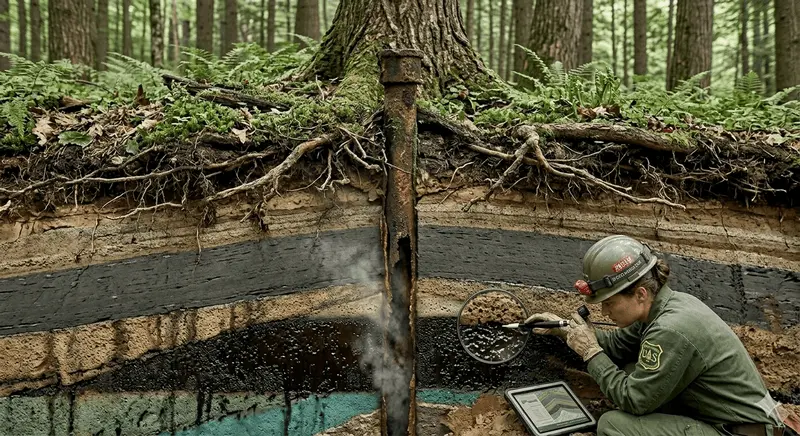
The "pools" of oil beneath the Allegheny National Forest are a masterpiece of structural geology. To understand why the world’s first oil boom happened here, we have to look at the specific Subsurface Geometry—a perfect alignment of ancient riverbeds, microscopic sponge-like rocks, and impenetrable stone "lids."
1. The "Sponge" Rock: The Venango Sands
Contrary to popular belief, oil does not sit in massive underground caverns or literal lakes. Instead, the oil of the Allegheny is held within the Venango Sandstones.
-
Ancient Shorelines: 360 million years ago, this region was a shallow coastal marine environment. The "pools" are actually ancient, buried river deltas and sandbars.
-
Microscopic Porosity: Imagine a jar filled with marbles. The oil lives in the tiny gaps (pores) between the grains of sand. In the best "pay zones" of the ANF, the rock has a porosity of 15% to 22%, meaning nearly a quarter of the solid-looking stone is actually open space filled with hydrocarbons.
-
The Riceville Shale: Sitting directly on top of the oil sands is a dense, fine-grained layer of shale. Unlike the sandstone, shale is impermeable—it has no connected pores.
-
The Seal: This shale acts as a geological "Teflon lid," pinning the oil down under immense pressure. When a drill bit finally pierced this lid in 1859, that pressure is what pushed the oil to the surface.
-
The Anticline: The layers form very broad, subtle upward arches called anticlines. Because oil is buoyant, it migrates to the very "crest" of these arches.
-
Targeting the Crest: Early wildcatters learned to look at the surface topography. Often, the highest ridges in the forest mirrored the "high points" of the oil pools deep below. This is why many of the most productive "Ghost Wells" (image_64.png) are found on the high shoulders of the plateau rather than in the valley floors.
-
Gas Cap: At the very top of the arch, natural gas (the lightest) collects.
-
Oil Column: Beneath the gas sits the oil.
-
Connate Water: At the bottom is ancient, incredibly salty "brine" left over from the Devonian seas.
2. The Stratigraphic Trap: The "Shale Lid"
Oil is lighter than water. Left to its own devices, it would float upward through the porous sandstone and evaporate at the surface. The reason the "Black Gold" stayed put for millions of years is the Stratigraphic Trap.
3. The Gentle Fold: The "Anticline" Geometry
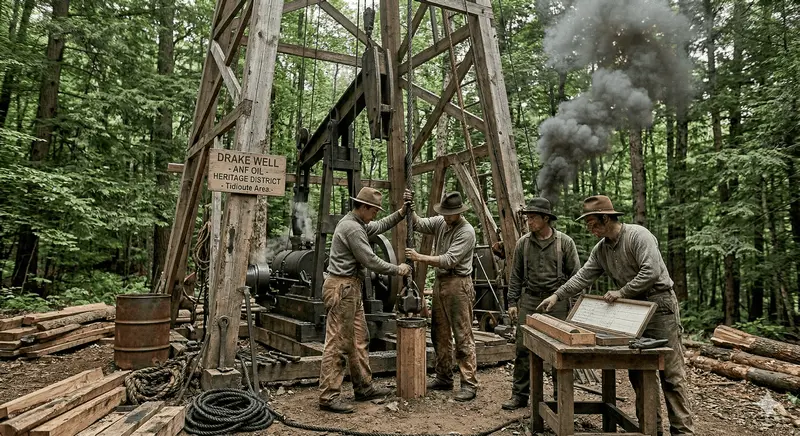
While the mountains to the east (the Appalachians) were crushed into sharp, broken peaks, the rocks beneath the ANF were only gently "warped."
4. The Brine Floor: Fluid Stratification
Inside the sandstone "sponge," the fluids are perfectly sorted by gravity. This is the Fluid Geometry of a well:
When a mitigation crew uses an OGI camera, they are often seeing the "Gas Cap" finally escaping because the "Shale Lid" was compromised by a century-old iron pipe.