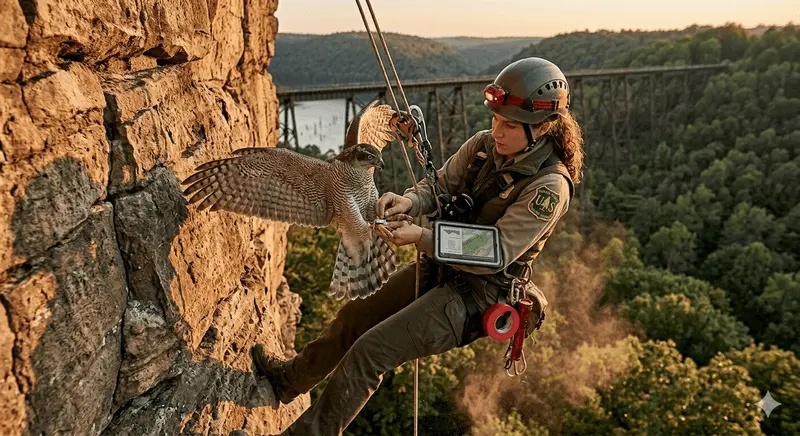
In the Allegheny National Forest, conservation isn’t always a quiet walk in the woods. Sometimes, it’s a high-stakes vertical operation performed hundreds of feet above the valley floor. While the "Dollar-a-Day Boys" of the CCC built the forest's foundation on the ground, a new generation of "High-Speed" specialists is protecting its most elusive residents: the apex predators of the sky.
The Northern Goshawk and the Peregrine Falcon are the ghosts of the Allegheny. To manage these species, biologists cannot simply observe from afar; they must enter the raptors' world—the sheer sandstone cliffs and the dizzying heights of the High Plateau.
1. The Vertical Laboratory
Raptor conservation in the ANF is an exercise in "extreme biology." Because these birds nest on inaccessible rock faces, traditional field methods are useless.
-
The Rigging: Biologists must be expert climbers, utilizing the same technical rope systems used in mountain rescue. As seen in the recent field documentation (image_60.png), a "Raptor Rescue" operation involves rappelling into the "void" to reach a nest ledge.
-
The Tools of the Trade: Every ounce of gear must be multi-functional. High-visibility red electrical tape (a hallmark of the ANF technical team seen in image_28.png and image_60.png) is used to mark safe rope lines and secure sensitive equipment in the high winds.
-
The ID Band: A small, lightweight aluminum band is placed on the bird's leg. This is the bird’s "Social Security number," allowing researchers to track its movements across North America for decades.
-
Health Assessment: Biologists check for parasites and take blood samples to monitor the impact of environmental toxins. In the Allegheny, this data is vital for understanding how the "Green Gold" timber industry and local ecology interact.
-
Digital Integration: As seen in the field, biologists use rugged, chest-mounted tablets (identical to the GIS units in image_28.png) to instantly log GPS coordinates and morphometric data.
-
The "Goshawk Attitude": Unlike the more famous Peregrine, the Northern Goshawk is notoriously aggressive in defending its nest. A biologist must often work while the adult parents dive-bomb them at speeds exceeding 50 mph.
2. The Science of the "First Flight"
The most critical moment for a young raptor is just before it leaves the nest. During this narrow window, conservationists perform "banding and tagging."
3. Precision Under Pressure
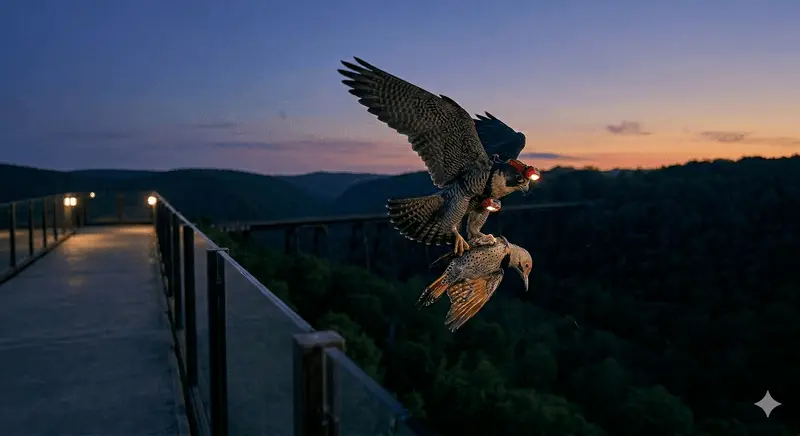
Working on a cliff face is a race against time and biology. The specialist must remain perfectly calm to avoid stressing the bird, all while suspended by a 10mm nylon rope.
4. Why the High-Speed Hunt Matters
The presence of these raptors is the ultimate grade for the forest. A healthy population of Goshawks means the "Stewardship in the Miniature" (image_58.png) is working; it means the small mammals and birds they hunt are thriving in the diverse undergrowth.
When a tagged falcon finally takes its first flight from a cliff near the Kinzua Skywalk, it carries more than just a metal band. It carries the data that will help preserve the Allegheny’s wild character for the next century. This is conservation at its most kinetic—a marriage of grit, geometry, and a deep respect for the hunters of the High Plateau.