Long before the CCC laid its first stone or the first oil derrick pierced the canopy, the Allegheny Valley was the ancestral home of the Onöndowa’ga:’ (People of the Great Hill), known today as the Seneca Nation. To understand the High Plateau is to understand that the "wilderness" we see today is a landscape deeply shaped by thousands of years of Indigenous presence.
The word Kinzua (pronounced kin-ZOO-uh) is a corruption of the Seneca word Kënzua, which translates literally to "fish on spear" or "logs on the water." It refers to a specific point in the river where the geometry of the currents made it ideal for fishing and navigating timber.
1. The Heritage of the "Trail Marker Trees"
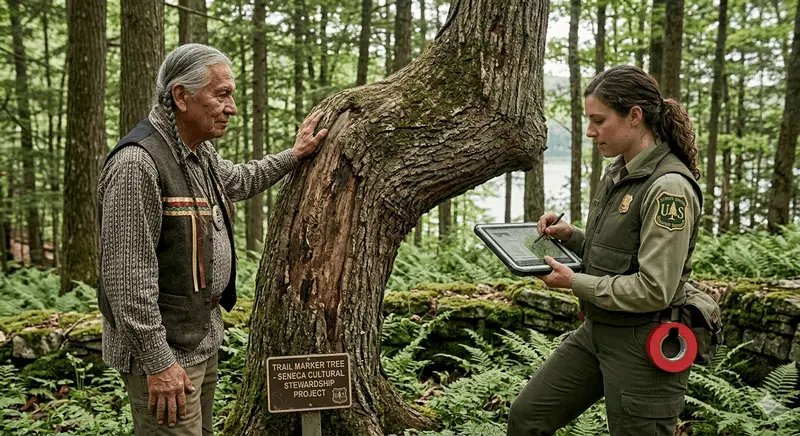
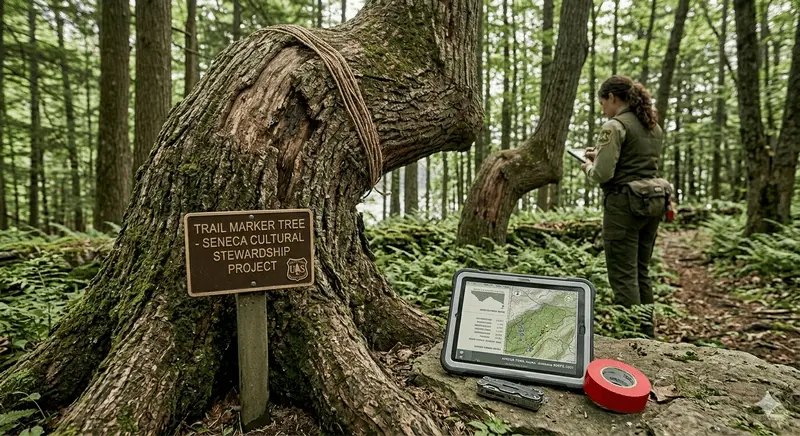
One of the most profound examples of cultural stewardship in the ANF is the preservation of Trail Marker Trees. These are not natural accidents; they are living land surveys.
Seneca travelers would bend young hardwood saplings—often white oak or maple—and tie them down with rawhide to point toward significant locations: a reliable spring, a shallow river crossing, or a high-plateau camp. Over a century, the tree would grow with a distinctive "elbow" or "hip" shape, its trunk permanently diverted to serve as a signpost for future generations.
2. The Cornplanter Grant: A Vanished Kingdom
The story of the Seneca in the Allegheny is inextricably linked to Gaiantwaka (Chief Cornplanter). Following the Revolutionary War, Cornplanter was granted a large tract of land along the river. For generations, this was a sovereign sanctuary where Seneca culture, language, and agriculture thrived.
However, the 1960s brought a traumatic shift. The construction of the Kinzua Dam flooded the heart of the Cornplanter Grant to create the Allegheny Reservoir. Over 600 Seneca families were forcibly relocated, and their ancestral homes, farms, and gravesites were submerged under the very water where tourists now boat and fish.
3. Modern Collaboration: GIS and Oral History
Today, cultural stewardship is a collaborative effort between the Seneca Nation’s Tribal Historic Preservation Office and federal foresters. It is a bridge between ancient oral tradition and 21st-century technology.
-
Digital Mapping: Using the same high-accuracy GIS tablets seen in our botanical surveys, stewards map "Culturally Significant Plants." These are areas where traditional medicines like black cohosh or specific basket-weaving materials (black ash) grow.
-
Ground-Penetrating Radar (GPR): Before any new CCC-style infrastructure is built, GPR is often used to ensure that hidden archaeological sites or ancestral footprints are not disturbed, honoring the "Ghost Army" of the past and the "Ancestral Presence" of the deep history.
4. The "Three Sisters" in the Wild
In the small clearings of the High Plateau, stewards look for remnants of the "Three Sisters" (Corn, Beans, and Squash). While the massive farms are gone, the wild descendants of these crops—and the sophisticated soil management techniques used to grow them—remain part of the forest's genetic memory.
Cultural stewardship reminds us that the Allegheny is not a "virgin" forest; it is a managed landscape. By recognizing the Seneca roots of the region, we move from being mere visitors to being part of a multi-generational chain of care.