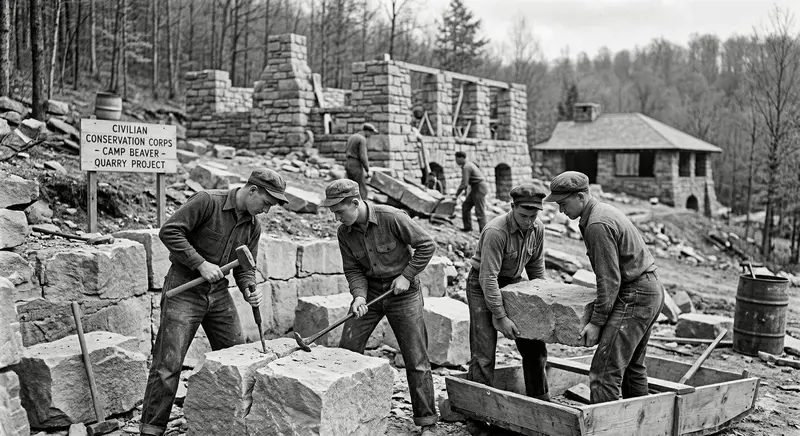
If you’ve ever sat at a hand-hewn picnic table under a massive stone pavilion in the Allegheny National Forest, or hiked a trail perfectly graded to shed water, you have walked in the footsteps of a "ghost army."
The Civilian Conservation Corps (CCC), established by Franklin D. Roosevelt in 1933, was a "New Deal" program designed to solve two crises at once: the devastating unemployment of the Great Depression and the ecological collapse of the American landscape. In Northwestern Pennsylvania, these young men—often called the "Dollar-a-Day Boys"—were tasked with an impossible mission: bringing a "dead" forest back to life.
1. From the "Pennsylvania Desert" to the ANF
By the early 1920s, the Allegheny Plateau had been decimated. Decades of unregulated "slash and burn" logging had stripped the mountains bare, leaving behind a scarred landscape known as the "Pennsylvania Desert." The hills were prone to massive erosion and devastating wildfires.
When the CCC arrived in 1933, they didn't just plant trees; they rebuilt the soil.
-
The Scale: Across Pennsylvania, the CCC planted over 50 million trees.
-
The Camps: Dozens of camps, like Camp Beaver and Camp Duhring, sprang up throughout the ANF. These were military-style barracks where young men aged 18–25 lived, worked, and sent $25 of their $30 monthly paycheck home to their families.
-
The Stonework: Look at the massive fireplaces at Twin Lakes or the retaining walls along the Allegheny River. Every stone was hand-quarried and hand-set.
-
The Infrastructure: They built the original roads that opened the ANF to the public, hundreds of miles of telephone lines for fire lookouts, and the first modern campgrounds.
-
Education: Camps offered night classes where men learned to read, write, and master trades like masonry, surveying, and heavy equipment operation.
-
Health: The average enrollee gained 11 to 15 pounds in their first three months due to the "three squares a day" and the rigorous physical labor in the fresh mountain air.
2. The Signature of the "Dollar-a-Day Boys"
The CCC didn't use bulldozers or power tools. They used picks, shovels, crosscut saws, and brute strength. Their work is identifiable by its "Rustic Architecture" style—a design philosophy that dictated structures should look as though they grew out of the ground.
3. Life in the Barracks: A Human Transformation
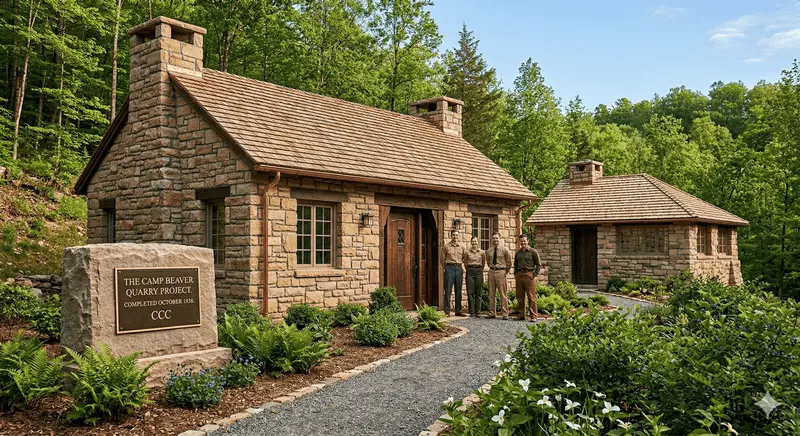
The CCC was as much about "building men" as it was about building forests. Many enrollees arrived at the ANF malnourished and underskilled from the inner cities of Pittsburgh, Philadelphia, and New York.
4. The Legacy: A Forest Reborn
When the program ended in 1942 as the nation pivoted to World War II, the "Ghost Army" vanished, but their work remained. The towering pines and hardwoods you see today in the ANF are, in many cases, the exact trees planted by a 19-year-old from the city 90 years ago.
The CCC Heritage Trail: Today, you can still find the foundations of the old camps hidden in the brush—concrete pads and stone chimneys that are being slowly reclaimed by the very forest they helped create. They are the quiet monuments to a generation that saved the American wild.