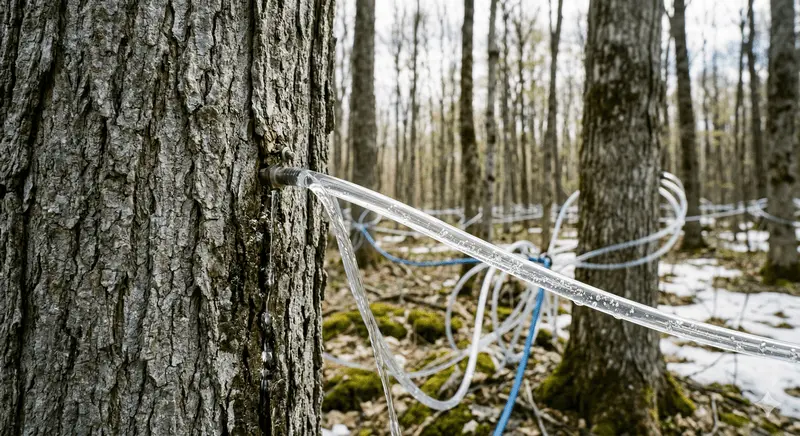
The snow may still dust the deep hemlock groves of the Allegheny National Forest, but the calendar—and the rising sap—tells a different story. In that specific, fleeting moment when the nights remain frozen and the days push toward forty degrees, the oldest spring tradition on the Plateau begins. It’s the "Sugar Run," and for the small, multi-generational sugaring operations dotting Warren and McKean counties, this is the sweetest time of the year.
This is the season of "Allegheny Gold."
The Science of the "Thaw"
Maple sugaring is entirely dependent on a delicate, natural binary. When temperatures drop below freezing at night, a negative pressure, or vacuum, is created within the tree, drawing water and minerals up through the roots. When the sun hits the bark the following day, the positive pressure pushes that nutrient-rich sap back down toward the roots.
It is this hydraulic action that creates the "flow."
"It's a dance between the frost and the thaw," says Elias Miller, a third-generation sugarmaker near Sheffield. "If it stays too cold, the sap never moves. If it stays too warm, the buds pop, and the sap turns 'buddy' (bitter). You have to catch that window."
That window is often just a few weeks long, typically from mid-March to early April on the Plateau, making every run critical.
From Bucket to Tubing: Tapping the Tradition
The method of collection is where the heritage of the Allegheny truly shines. While large, commercial operations utilize expansive vacuum tubing networks and reverse osmosis (RO) machines to pre-concentrate the sap, many operations on the Plateau still honor the older, slower ways.
The simple, iconic image of a tin bucket hanging from a maple spile is still common in the ANF. This method is a labor of love, requiring daily, manual collection. The sap collected this way must be boiled almost immediately, as it spoils quickly.
Contrast this with a modern, sustainable operation. Miles of food-grade tubing connect thousands of taps directly to a central sugar shack. Using high-vacuum systems and RO technology (which can remove up to 75% of the water before boiling), these producers can generate hundreds of gallons of syrup in a single season, maintaining efficiency without sacrificing quality.
"The RO saves us days of boiling time," Miller explains. "It’s about sustainability and respect for the woodlot. Less wood burned, less time on the evaporator, but still that same classic flavor."
The "Boil" and the Flavor of the Plateau
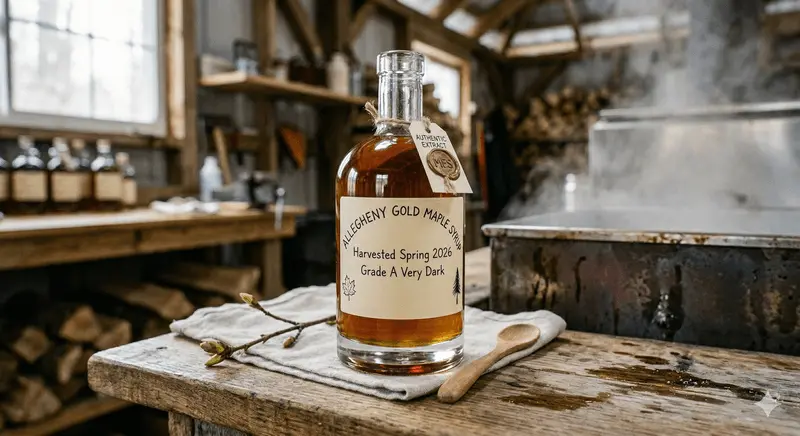
Regardless of how the sap is collected, the final destination is the same: the evaporator.
This is where the magic (and a tremendous amount of steam) happens. It takes approximately 40 gallons of clear sap to produce just one gallon of finished maple syrup. When you enter a sugar shack during the boil, the intense, sweet aroma is overwhelming—a concentration of the entire spring forest.
The ANF soil composition (acidic, rocky, loam) influences the flavor of the sap, often producing a "darker, robust" syrup known as Grade A Very Dark/Strong Taste. This grade, formerly classified as Grade B, is treasured on the Plateau for its deep, caramel-like complexity, making it ideal not just for pancakes, but for glazes, baking, and even coffee.
The finished product is carefully tested with a hydrometer to ensure it reaches 66.9 degrees Brix (the legal standard for syrup density) before it is filtered, bottled, and sealed.
The Sugar Shack Trail
Maple sugaring is not just an agricultural pursuit; it is a community ritual. Each spring, local fire halls host pancake breakfasts, and family-run sugar shacks open their doors to visitors curious about the process.
While the Gazette does not post specific operating hours, we encourage you to seek out the local 'Heritage Gold.' Look for hand-painted signs on backroads or check with the local Chambers of Commerce for listings of participating sugar shacks.
Heritage Note: When you see that gold in the bottle, you are looking at forty-fold concentration of the Allegheny's spring energy. Taste it, and you taste the Plateau itself.