The Seven-Rung Ladder and the Native Blue
Note: This account details the May excursion into the untracked "Gap" tributaries of the Allegheny plateau.
The truck didn't just stop; it sighed, a long, rhythmic hiss of steam from the radiator that sounded suspiciously like a warning. We had pushed it as far as the rutted logging track would allow, parking it on a slant that made the doors groan. Ahead of us lay no trail, only a nameless tributary—a "Blue Line" on a map that existed mostly in Hoag’s memory. We were after Brook trout, the native kind that Hoag claimed had scales like stained glass and hearts like mountain lions.
"Check your laces, Pip," Hoag muttered, tightening the strap on his creel. "The creek doesn't flow flat for our convenience. Up here, water is just a long series of falls, and every one of 'em is a gatekeeper."
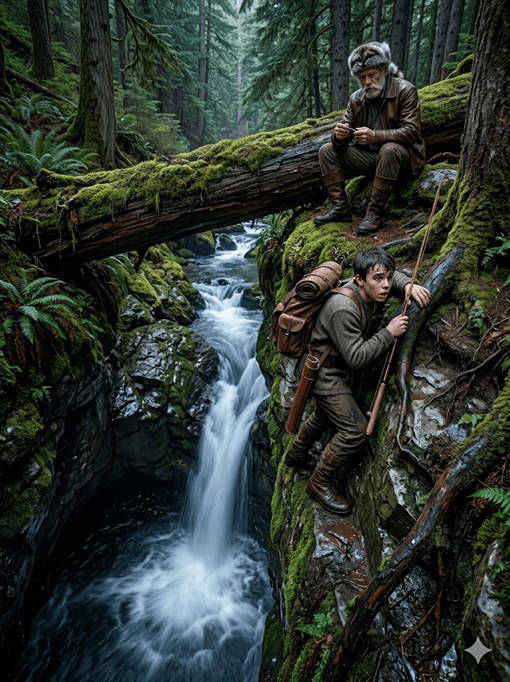
The first hour was a masterpiece of misery. The tributary was a "Seven-Rung" stream, meaning it climbed the plateau in seven distinct, vertical limestone benches. We weren't fishing; we were mountaineering with bamboo fly rods. The air was thick with the scent of crushed ferns and the cold, mineral breath of the rocks. Hoag moved with a frustrating, slow-motion grace, his gnarled staff finding purchase on moss-slicked ledges that looked like glass to me. I followed, my lungs burning, my backpack feeling like it was filled with lead shot instead of sandwiches.
The Seven-Rung Ladder and the Native Blue
"You’re breathing like a steam engine, boy," Hoag called down from a ledge ten feet above. "You’re scaring the fish before we even see the water. Breathe through your nose. Keep your center over your boots, not in front of 'em."
The suspense arrived at the Fourth Rung. The gorge narrowed until the limestone walls were close enough to touch with outstretched arms. The water here didn't fall; it hammered into a deep, black pool that looked bottomless. To get past it, we had to "walk the seam"—a three-inch lip of rock caked in wet mud and prehistoric-looking moss. It was here that my confidence evaporated. One slip meant a twenty-foot plunge into a pool that probably hadn't been above forty degrees since the ice age.
I froze. My left boot was vibrating with a tremor I couldn't stop. Hoag, already on the other side, didn't offer a hand. He sat down on a mossy log, pulled out his pipe, and began to clean a fingernail with a small pocketknife. The humor of the situation was entirely lost on me at the time, though the sight of him looking so bored while I faced certain doom was objectively ridiculous.
"Take your time," he said, his voice barely audible over the roar. "The trout have been there ten thousand years. They can wait another ten minutes for a boy who’s afraid of a little dampness."
Anger, it turns out, is a great cure for vertigo. I jammed my fingers into a crack in the limestone, felt the bite of the cold stone, and shuffled across. When I reached the far side, dripping with sweat despite the cold, Hoag didn't congratulate me. He just stood up, knocked his pipe against a tree, and pointed to the Fifth Rung.
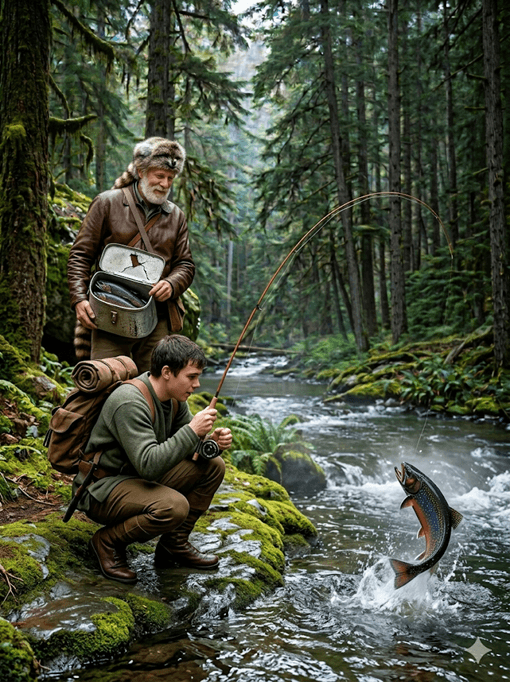
We reached the "Top Room" by noon. It was a cathedral of ancient hemlocks, the canopy so thick it felt like twilight. The creek here finally leveled out, meandering through beds of bright green watercress. It was silent, save for the occasional *plop* of a rising fish. We rigged our lines in silence. Hoag took the lower pool, and I moved upstream, my heart finally slowing down.
I cast a small, bushy dry fly into a foam-flecked eddy. The strike was instantaneous—not a splash, but a determined gulp. When I brought the fish to the net, it was the "Native Blue" Hoag had promised. It was only seven inches long, but its flanks were a galaxy of crimson spots with blue halos, its belly the color of an October sunset. I felt a surge of triumph that made the climb seem like a walk in a city park.
"Not bad," Hoag said, appearing behind me like a ghost. He held up his own creel, showing three similar beauties. "But look at your rod tip, Pip. You’re holding it like a club. These fish are made of glass and lightning. Treat 'em with some manners."
The descent was faster but no less treacherous. We reached the truck as the first evening shadows were stretching across the logging road. My legs felt like they belonged to someone else, and my back was a map of new aches. But as the engine turned over—on the fourth try, with a plume of blue smoke—I looked at the silver creel in the footwell and realized the "Seven-Rung" ladder wasn't about the fish. It was about the price of the view.
“A trout doesn’t live in a place that’s easy to get to. If it was easy, it’d be a catfish, and we’d be sitting on a porch instead of climbing a wall.”
~ Hoag Mossback