The Ramp Patch and the Heavy Manners
The Ramp Patch and the Heavy Manners
Note: An account of the spring forage into the deep-soil hollows of the Kinzua plateau.
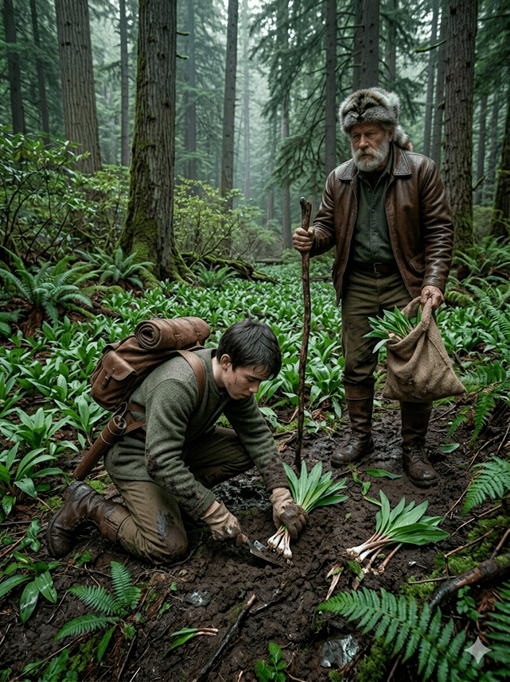
The truck had been parked for less than ten minutes before the scent of the hollow took over. In mid-May, the Kinzua doesn't just smell like woods; it smells like a kitchen. We were after ramps—wild leeks that grow in the black, saturated soil of the spring seeps. They are the first true gift of the season, a pungent mix of garlic and spring onion that can wake up a palate dulled by a winter of salt pork and potatoes. I had a burlap sack tucked into my belt and a trowel in my hand, ready to fill the larder.
"Keep your head up, Pip," Hoag said, his muzzleloader cradled in the crook of his arm. "The green-up brings everything out of the rocks. You spend too much time looking at the dirt, and you'll miss the manners of the folks who got here before us."
We dropped into a deep, limestone-bottomed ravine where the sun only hit the floor for an hour at noon. The ramps were there in thousands, their broad, spear-shaped leaves shimmering with a light coating of morning dew. I set to work, the wet soil caking under my fingernails as I dug. Hoag stood ten yards uphill, leaning against the gnarled trunk of a yellow birch, his eyes scanning the thickets of witch hazel and mountain laurel. He wasn't digging; he was watching the wind.
"You’re taking the big ones, boy," he critiqued, his voice low but sharp. "Leave the mothers. Take the middlings and move on. You strip a patch bare and you’re just stealing from the future. And keep the noise down. You're scraping that metal like you're trying to wake the dead."
"I'm just trying to get through the roots, Hoag," I muttered, my back beginning to ache. "It’s a quiet hollow. There’s nothing here but us and the gnats."
I reached for a particularly lush cluster near the base of a lightning-scarred hemlock when the air in the hollow seemed to thicken. It wasn’t a sound at first, but a pressure—a sudden, heavy realization that the "quiet" I had been enjoying was actually a silence born of caution. Then came the huff. It was a wet, guttural expulsion of air that sounded like a heavy bellows being compressed. I froze, my fingers still wrapped around the muddy white bulbs of the ramps.
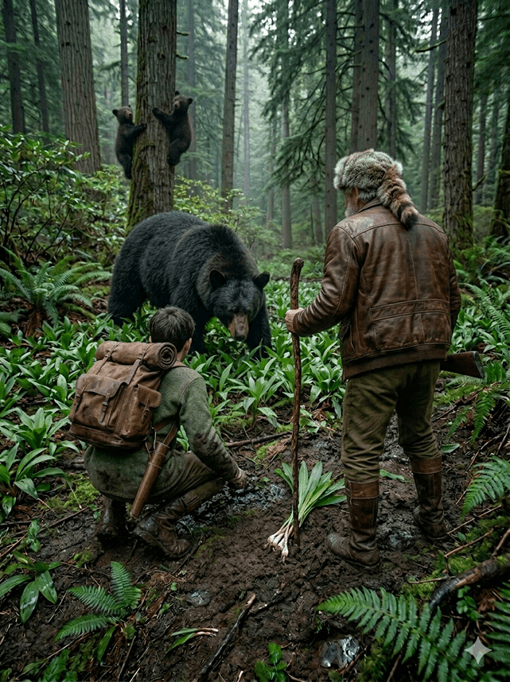
Thirty feet away, behind a screen of emerging ferns, a black bear stepped into the open. She was a sow, thick-necked and heavy-set, her coat a dull, light-absorbing black that looked almost blue in the deep shade. She didn't growl; she didn't have to. She simply lowered her head and swung it in a slow, rhythmic arc, her nostrils flaring as she sorted through the overwhelming scent of crushed leeks to find the human intruder. Then, two smaller shadows tumbled out from behind her—cubs, no bigger than house cats, their fur frizzy and unkempt. They let out high-pitched chirps and immediately scrambled ten feet up the nearest maple.
The suspense was a cold weight in my chest. I was crouched in the mud, lower than the sow, which is a very poor position to be in when manners are being negotiated. She took a step forward, her claws clicking against a submerged limestone rock. She was protecting the patch, and I was sitting right in the middle of it.
"Stand up, Pip," Hoag’s voice came from the birch tree, as steady and calm as if he were calling for a cup of coffee. "Slowly. Don't drop the sack, and don't turn your back. You move like a man, not like a rabbit, and she might decide you're not worth the energy."
I rose to my feet, my legs feeling like they were made of water. The sow let out another huff, sharper this time, and popped her jaws—a sound like two dry boards being struck together. It was a clear warning. We were locked in a standoff. She looked at me, then up at her cubs, then back at the old man standing uphill. Hoag didn't raise his rifle, but he didn't lower it either. He began to talk to her, his voice a low, conversational rumble that seemed to settle the vibrating tension in the air.
"Easy now, girl. We’ve got no quarrel with you. We’re just here for a taste of the green, same as you. We're leaving the patch. It’s all yours."
The humor of the moment—the sheer absurdity of Hoag trying to reason with four hundred pounds of maternal instinct—was lost on me until later. At the time, it was the only thing keeping me from running. We backed away, one slow, deliberate step at a time, keeping our eyes on her but never staring her down. The sow watched us with an intensity that made the hair on my arms stand up. When we had cleared the edge of the ravine, she let out a final, commanding "woof." The cubs dropped from the maple and followed her into the brush, disappearing with a silence that seemed impossible for creatures that size.
We hiked back to the truck without saying a word. My burlap sack was only half-full, but the smell of the ramps in the confined space of the cab felt like a victory. Hoag didn't start the engine right away. He reached into his pocket, pulled out his pipe, and looked at my mud-stained hands.
"You learned two things today, Pip," he said, the ghost of a smile tugging at the corner of his mouth. "One, ramps taste better when you don't have to fight for 'em. And two, in this woods, you never, ever dig a hole you aren't prepared to stand up out of in a hurry."
“A bear doesn’t care about your hunger. She only cares about her own and the safety of the things that follow her. If you can’t learn to share the hollow, you’ll eventually find yourself being the only thing on the menu.”
~ Hoag Mossback