The Ghost of the Glade
The fog in the Kinzua bottomlands doesn’t just sit; it has an agenda. It’s a heavy, gray soup that smells of rotting cedar and damp wool, and it possesses the supernatural ability to turn a solid trail into a vertical slide of slick clay the moment you stop paying attention.
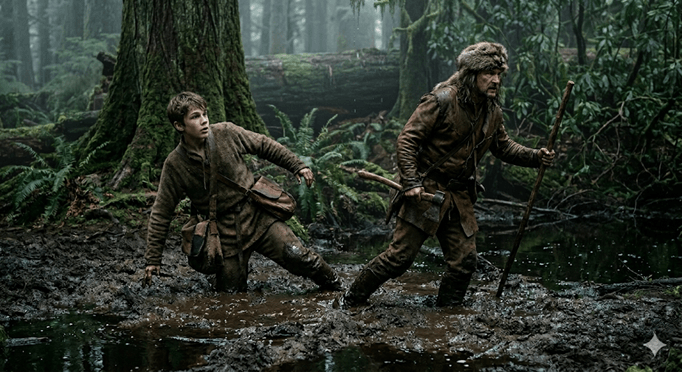
I was currently halfway through a masterclass in "unplanned excavation." My left leg was buried up to the hip in a peat bog that sounded like a giant clearing its throat every time I moved.
"Hoag," I whispered, trying to maintain some dignity while looking like a half-planted turnip. "I believe the Allegheny has developed a taste for my breeches."
Hogarth "Hoag" Mossback stopped ten paces ahead. He didn't turn around. He stood so still that a winter wren actually landed on his shoulder, mistaking him for a particularly judgmental stump.
"You're fightin' the mud, Pip," Hoag rasped. "The mud is like a bad marriage—the more you struggle, the tighter it holds. Stop exertin' yourself and start existin'. Think like a lily pad."
"Lily pads don't wear water-logged cowhide boots, Hoag!" I heaved, and the bog responded with a wet, flatulent thwack that echoed through the silent trees.
"Hush," Hoag snapped, the wren taking flight. "You’re buglin' louder than a lonely bull. We’re in the parlor of the Ghost now, and he don't take kindly to city-boys makin' bathroom noises in his woods."
We were tracking a legendary Eastern Elk that the locals called "The Ghost." According to Hoag, this beast was so large it didn't just walk through the brush; it rearranged the local geography. I’d spent three hours doubting him, right up until we found a rubbing on a massive white pine. The bark had been stripped away six feet up, and there were tufts of coarse hair caught in the sap that looked more like bear fur than deer.
Hoag touched the sap. He tasted it. I winced.
"He's close," Hoag whispered. "And he's irritable. His cows have moved up-creek and he’s lookin' for a fight. If he finds you, Pip, try not to look like a sapling. He’s in a mood for splinterin' things."
We crept toward a limestone shelf that overlooked a hidden glade. The air here was different—thick with the musky, sharp scent of an animal that weighed more than a blacksmith's anvil. Then, the sound tore through the mist. It started as a high-pitched scream that made my scalp crawl and dropped into a deep, vibrating rumble that I felt in my very marrow.
The Ghost of the Glade
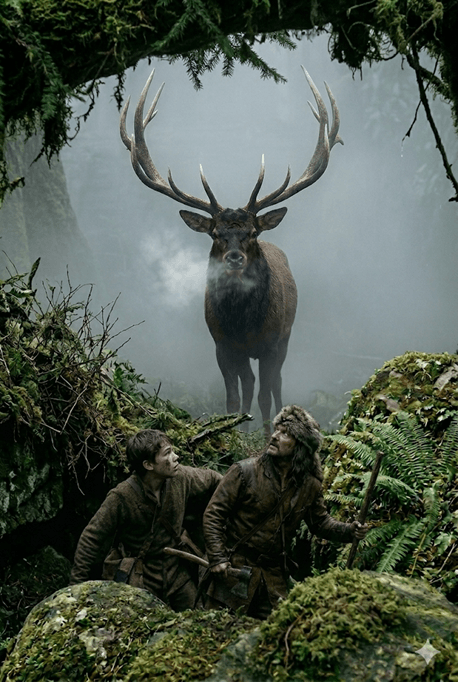
The Ghost emerged from the gray veil like a nightmare made of muscle and ivory. He was terrifying. His rack was a massive, sweeping cathedral of bone, and his neck was as thick as a beer barrel. He bugled again, spraying a mist of hot breath into the cold morning air.
He was fifty yards away, but he felt like he was standing on my chest.
"Hoag," I hissed, my knees knocking together with a rhythmic click-click-click. "I’ve decided I don't need to see an elk. I’ve seen enough. I’m ready to go home and learn to knit."
"Don't move," Hoag breathed, his hand like a vise on my shoulder. "He’s testin' the wind. He knows there’s somethin' foul in the air, he just hasn't pinned it on your cowardice yet."
The bull lowered his head, raking a patch of mountain laurel into green confetti. He was a king in his prime, and he was looking for a challenge. Unfortunately, at that exact moment, the salt pork I had tucked into my pocket decided to shift.
The crinkle of the wax paper sounded like a musket shot in the silence.
The Ghost froze. His massive head swung toward us. His dark, liquid eyes locked onto the limestone ledge. He let out a sharp bark—a warning—and took two steps toward us, his hooves striking the stone like hammers.
"Hoag!" I squeaked, reaching for my hemp rope as if I could lasso a mountain.
"If you run, he’ll have you for a hood ornament before you hit the creek," Hoag said, his voice as calm as a frozen pond. "Just stand tall. If he charges, jump left. Elk are like lawyers—they’re terrible at turnin' corners once they’ve made up their minds."
The bull elk huffed, a great cloud of steam erupting from his snout. He sized us up—two scrawny, mud-covered bipeds perched on a rock. He must have decided that we were too pathetic to be a threat and too stringy to be a snack. With a final, dismissive toss of his ivory crown, he spun around and vanished into the hemlocks with the silence of a literal ghost.
I collapsed onto the limestone, my heart hammering a frantic rhythm against my ribs.
"He... he didn't kill us," I panted.
Hoag looked down at me, a ghost of a smirk hidden in his beard. He reached into my pocket, pulled out the wax-wrapped salt pork, and took a bite.
"Course he didn't," Hoag said, chewing slowly. "Even a beast that big has standards, Pip. He likely thought you were a diseased stump and didn't want to catch whatever was makin' you shake so bad."
He started walking again, his moccasins silent on the stone. "Now get up. We’ve wasted a perfectly good bugle, and there’s a trout stream two miles north that won't wait for your legs to stop turnin' into jelly."
I stood up, my breeches still caked in bog-mud, and followed. I realized then that in the Kinzua, you aren't judged by your bravery—you're judged by whether or not you're worth the effort of an animal's anger.
I was currently very, very safe.
Hoag’s Hard Truths
"A bull elk is a lesson in humility with four legs and a crown of bone. If he looks at you and walks away, don't think you've outsmarted him. Just realize he’s got better things to do than stomp a grease-spot into the dirt."