The Treaty of Canandaigua (1794) wasn't just any document; it was one of the earliest treaties in U.S. history. George Washington himself promised the Seneca that the land would be theirs for as long as "the sun rises and the river flows."
When the U.S. Army Corps of Engineers moved to build the dam in the 1960s to protect Pittsburgh from flooding, they essentially told the Seneca that the sun had set. This move was so controversial that even Johnny Cash recorded a famous protest song about it called "As Long as the Grass Shall Grow."
The Submerged Ghost Towns
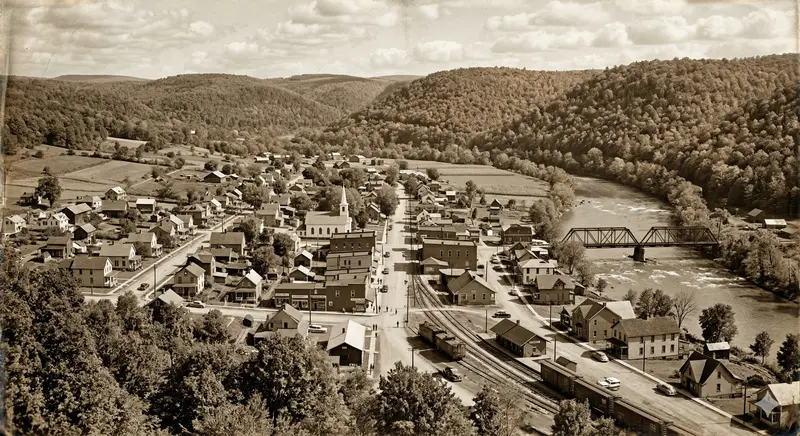
When the valley was flooded, it didn't just cover trees; it swallowed entire communities.
-
Corydon and Kinzua: These were small, thriving towns. Before the flooding, houses were moved, but many foundations, roads, and orchards were simply left behind.
-
The "Scuba Lore": Divers who have explored the reservoir (though visibility is notoriously poor) often describe a haunting landscape of silt-covered roads and fence lines that still lead to nowhere.
-
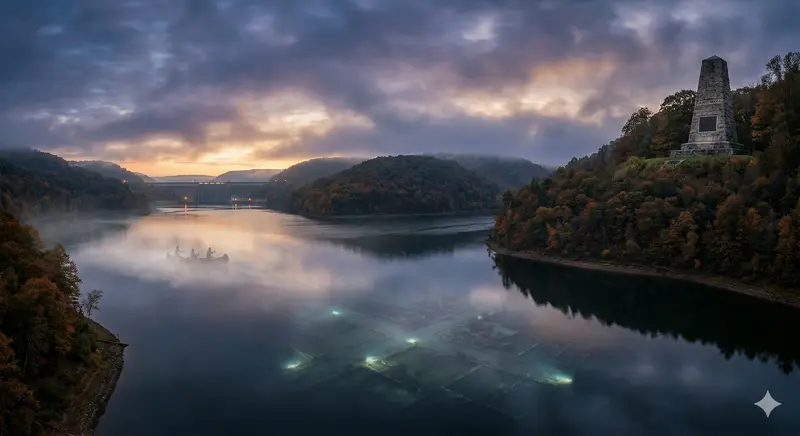
The Phantom Lights: Locals and campers often report seeing lights shimmering deep under the water near the old town sites on quiet nights—speculated to be the "spirits" of the homes that were lost.
-
The Monument: His remains were moved to a hilltop cemetery overlooking the new lake.
-
The Lore: There is a persistent belief among some locals and researchers that not all the remains were successfully moved, or that the spiritual "connection" to the land was severed so violently that the area remains restless. This is often cited as the reason for the "heaviness" people feel when kayaking the quietest arms of the reservoir.
The Exhumation of Chief Cornplanter
Gaiantwahka (Cornplanter) was a visionary leader who had worked tirelessly to find a peaceful path between his people and the new American government.
The "Irony" of the Dam
There is a bit of "modern lore" regarding the dam's construction:
Despite the dam being built for flood control, many in the Seneca Nation pointed out that the engineers' own models were initially flawed, and the flooding of the sacred land was more about political convenience than absolute necessity. This sense of unnecessary sacrifice is what fuels the "perfidy" (treachery) aspect of the legend.