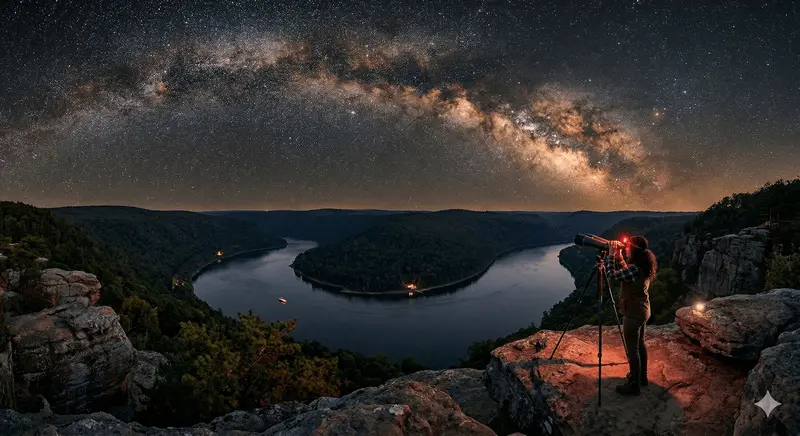
The modern world has eradicated true darkness. For 80% of North Americans, the view from their back porch is a smog of amber streetlights, digital screens, and the diffused glow of a neighboring city. We are a people who have lost our relationship with the cosmos.
But not here. In the deep interior of the Allegheny National Forest (ANF)—atop the vast, isolated High Plateau—there is a sanctuary for the shadows. Here, the velvet blackness of the night is not a void; it is a canvas of light, so vivid and close it seems to press against your skin.
1. The Geometry of Darkness
Northwestern Pennsylvania holds a secret weapon in the fight against light pollution: topography. The ANF sits on a massive sandstone plateau, carved by rivers into deep valleys. While the edge of the plateau faces the lights of Erie, Buffalo, and Pittsburgh, the interior folds in on itself, creating a natural shield.
-
The High Plateau: When you stand on a high point like Jakes Rocks (at over 1,900 feet) after midnight, you are above the humidity of the valleys and separated from the nearest meaningful artificial light by thirty miles of trackless forest.
-
The Scale: This creates what astronomers call Bortle Class 2 or 3 skies. Under these conditions, the Milky Way is not a faint smudged line; it is a river of light with discernible dusty structures and dark rifts, casting a distinct shadow on the ground.
-
Red Lights Only: White light destroys "night vision" instantly. Wrap your flashlight in red cellophane or use a red headlamp. It takes the human eye twenty minutes to reset to full darkness.
-
Arrive Early: Set up your telescope, camera, or chair before the sun goes down to avoid driving with headlights and blinding other observers.
-
Think Vertical: Don't just look for "planets." Use binoculars to explore star clusters (the "Pleiades" or the "Coathanger") that are hidden by light pollution in the suburbs.
-
Jakes Rocks Scenic Overlook: Famous views, open horizon, easy access. (The gold standard).
-
Rimrock Overlook: A direct, framed view of the darkest section of the sky looking east across the Kinzua Valley.
-
Tracey Ridge Trailhead: High altitude and total isolation (primitive, bring full supplies).
2. Jakes Rocks: The "Cathedral of the Cosmos"
If the ANF is a sanctuary, then the rocky overlook at Jakes Rocks is its high altar. By day, it is a famous view of the winding Allegheny Reservoir. By night, the viewpoint transforms into an observatory without a roof.
What to Look For (Season by Season)
Spring: The "Galactic Anticenter" faces away from the core of the Milky Way, allowing for spectacular views of deep-sky objects like the Leo Triplet and the Whirlpool Galaxy. Summer: The season of the Perseids. The core of the Milky Way (Sagittarius) rises high, illuminating the southern horizon like a slow-burning fire. Autumn: When the humidity drops, the clarity is breathtaking. Look for the faint "Great Andromeda" (M31), the most distant object visible to the naked eye at 2.5 million light-years. Winter: The darkest, clearest skies. The constellation Orion reigns supreme, its Great Nebula glowing as a fuzzy patches of star-forming gas.
3. The Modern Hunt for "True Dark"
The ANF is uniquely positioned to become one of the premier Astro-Tourism destinations on the East Coast.
How to Practice Astro-Etiquette
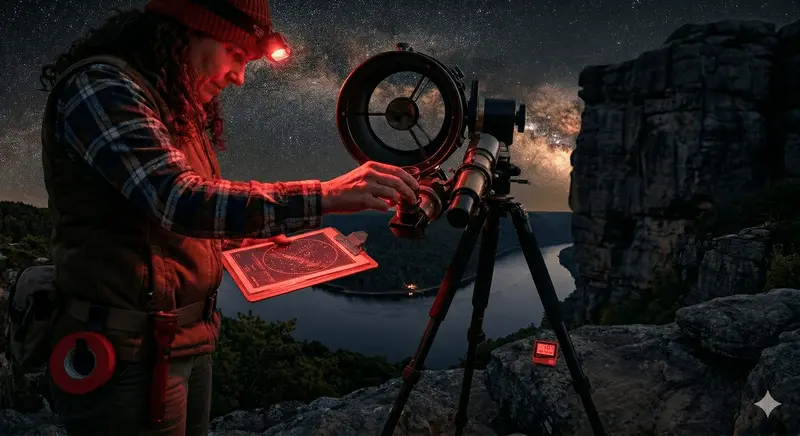
If you are heading to the High Plateau, remember that "True Dark" is a resource that requires strict preservation:
4. Summary: The Final Frontier of Silence
The experience of True Dark on the High Plateau is about more than stargazing; it is an act of restoration. In the profound, heavy silence of the ANF, the sight of a billion suns reminds us of our scale, our shared history, and the primal need to sometimes just stand still and look up.